
The Groove 273 - The New Medici Have HBO
Welcome to the 273rd issue of The Groove.
I am Maria Brito, an art advisor, curator, and author based in New York City.
If you haven’t done so, please subscribe here, to get The Groove in your inbox for free every Tuesday.
The new medici have hbo
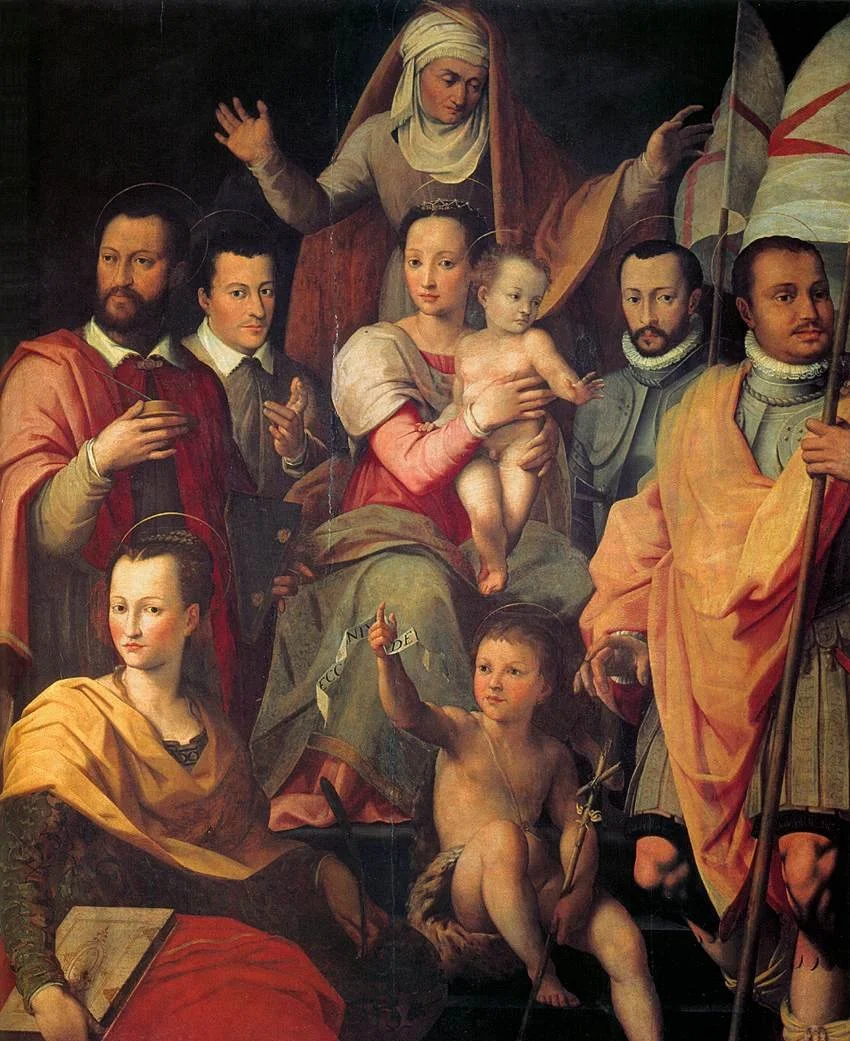
Giovanni Maria Butteri, Virgin and Child with St Anne and Members of the Medici Family as Saints, Cenacolo di Andrea del Sarto Florencia, 1575. Oil on panel commisioned by Isabella de Medici. Collection of the Museum of the Last Supper of Andrea del Sarto, Florence.
Culture used to be inherited. Now it can be acquired in a merger. Paramount’s proposed $111 billion takeover of Warner Bros. Discovery would put Paramount Pictures, Warner Bros., HBO, CBS, CNN, DC and a library of more than 15,000 titles under one corporate roof.
Harry Potter, Game of Thrones, Mission: Impossible, Star Trek, Top Gun, Batman. These aren’t just assets. They’re first dates, childhood obsessions, Sunday nights on the sofa and movies people remember watching with parents or grandparents who are no longer alive.
Hollywood may be America’s most successful form of soft power: exporting not just movies and television, but language, fashion, values, fantasies, and an idea of what America is.
And the fight over who gets to own all of this has become almost as dramatic as the content itself. California and 11 other states, all represented in the lawsuit by Democrat attorneys general, are trying to stop the deal, arguing that the combination could raise prices, suppress wages and give one company too much power over what gets made and distributed. Paramount says the merger is precisely what will allow it to compete with Netflix and Disney.
But underneath the antitrust lawyerly argument is a much older and weirder question. When you buy the company that owns the stories, how much of the culture do you actually own?
Someone Always Pays for the Renaissance
We romanticize culture of the past as something brilliant people made and the world miraculously discovered. Please. Culture has always had gatekeepers. The Medici financed the Renaissance artists who helped make Florence Florence: Michelangelo, Da Vinci, Botticelli.
In the nineteenth century, Paul Durand-Ruel bought around 12,000 Impressionist paintings - 1,000 Monets and 1,500 Renoirs among them, while much of Paris still considered the artists ridiculous. Monet later said that without Durand-Ruel, the Impressionists would have “died of hunger.” Money has decided what gets enough oxygen to become culture for centuries.
Sometimes ownership becomes an attempt to control meaning itself. Albert Barnes amassed the world’s largest collection of Renoirs: 179 paintings, plus 69 Cézannes and major Matisses, Soutines and Modiglianis. He arranged them according to his own visual logic and tried to dictate how the collection would be experienced after his death. Decades later, his foundation fought a bitter legal battle to move the collection from Merion to a new museum in Philadelphia, despite Barnes’s instructions that it remain essentially as he left it. The argument wasn’t really about who owned the Renoirs. It was about who gets to decide how culture lives once its original owner is gone.
So gatekeepers aren’t automatically villains. Durand-Ruel nearly went broke backing artists nobody wanted. Great galleries still do versions of this today. Culture needs patrons, dealers, publishers, studios and museums willing to finance risk. The problem begins when patron, distributor, archivist and megaphone start becoming the same person.
Make Hollywood Great Again?
This is where the Ellisons make the story much more interesting. Larry Ellison gave around $45 million to a nonprofit supporting Trump’s 2024 election efforts and has grown closer to the president. His son, David, now runs Paramount. If Warner joins the empire, the family doesn’t simply gain another movie studio: CNN joins CBS News inside the same corporate structure.
You can understand why Democrats are nervous. You can also understand why the Ellisons think politics is contaminating an antitrust fight.
Meanwhile Paramount has reportedly threatened to move operations out of California if the dispute isn’t resolved, prompting California AG Rob Bonta to call the threat “blackmail.” The whole thing is starting to feel less like Succession and more like the court of Louis XIV: the king, the billionaires, the courtiers and the people trying to figure out who currently has the king’s ear.
But here’s where I refuse the easy partisan conclusion. I would be equally uncomfortable if the billionaires were left-wing. The issue isn’t whether Larry Ellison belongs to the court of Trump. It’s what happens when enormous financial power, entertainment, news and political proximity converge. If the same kingdom owns the movie that entertains you and the newsroom that explains the world to you, it is reasonable to ask how large we want that kingdom to become.
Everybody Has a Camera but Only a Few Own the Megaphone
The internet was supposed to destroy gatekeepers. And in one respect, it did: anyone can make a movie, release a song, show a painting or publish an opinion. A kid can create something in his bedroom tonight and reach ten million people by breakfast. Never in human history has cultural production been this democratic.
But we confused the democratization of creation with the democratization of attention. There may be infinite creators, but enormous amounts of attention still flow through a surprisingly small number of platforms, studios, streaming services, publishers, museums, auction houses and mega-galleries. The velvet rope disappeared. The algorithm replaced it. Now some of the old gates are getting welded together.
I don’t think gatekeepers are the enemy. Culture has always needed people willing to bet money, reputation and power on what they believe deserves to exist. The Medici did it. Durand-Ruel did it. Great galleries, publishers and studios still do it.
What worries me is when patron, distributor, archivist and amplifier become the same person. We should want many people making the decisions of what reaches us. Not because they all need to agree, but precisely because they shouldn’t.