
The Groove 274 - Peak Millennial Art
Welcome to the 274th issue of The Groove.
I am Maria Brito, an art advisor, curator, and author based in New York City.
If you haven’t done so, please subscribe here, to get The Groove in your inbox for free every Tuesday.
Peak Millennial Art
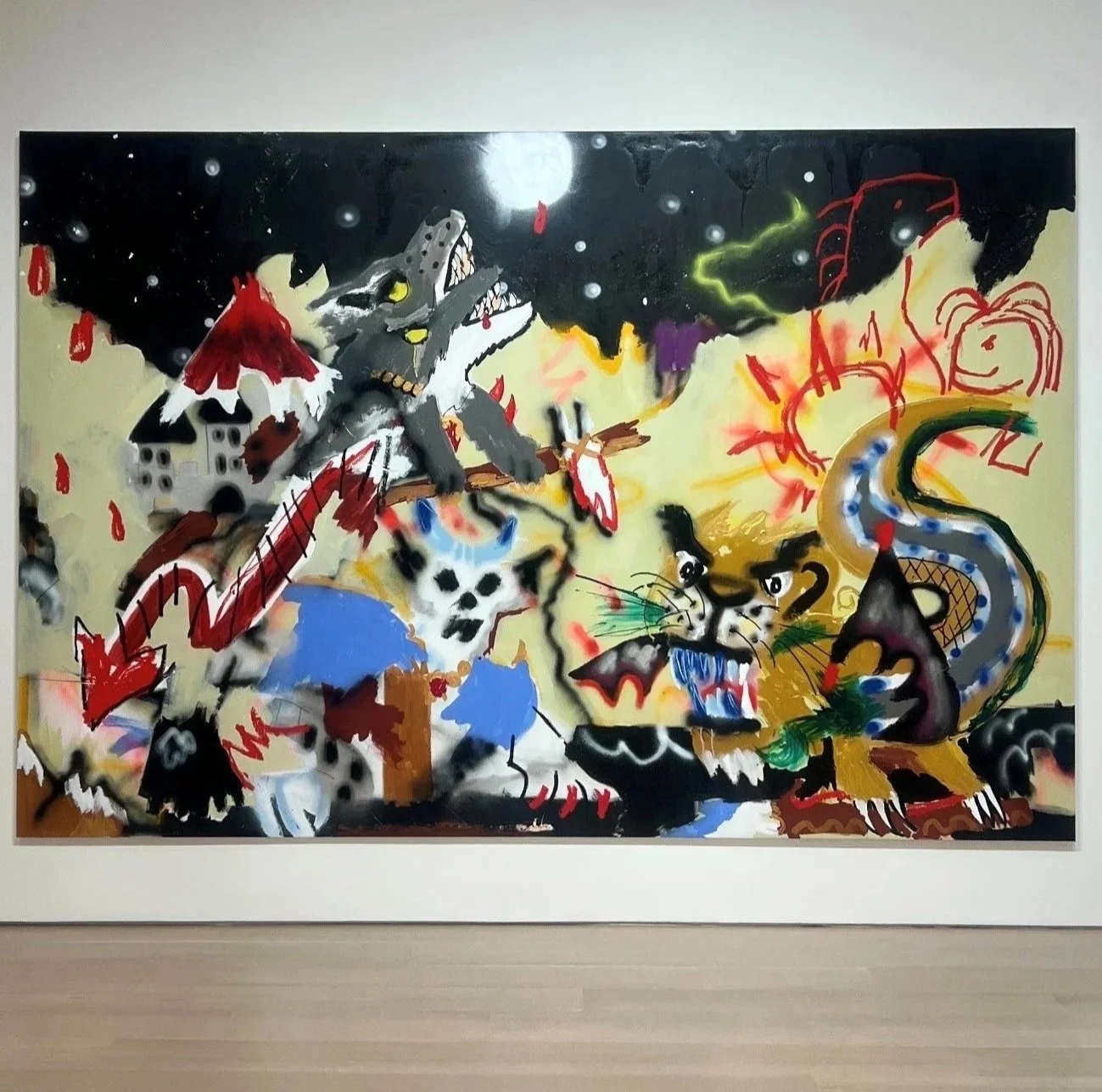
Robert Nava, Protecting My House, 2024. Oil, acrylic, graphite and mica on linen. I took this picture at Pace Gallery in New York in March 2025 during Robert’s first solo show with the gallery.
In 2014, artist and critic Walter Robinson looked around the art world, noticed a suspicious amount of similarly tasteful abstraction, and gave it a name: Zombie Formalism. The phrase stuck because it did what good cultural criticism is supposed to do: it made you see a pattern that had been sitting in front of you all along. Robinson was describing reductive abstraction that revived old formalist languages at precisely the moment collectors were furiously buying and flipping young artists. The term was not exactly a compliment.
I’m not an art critic, but I’m going to attempt to coin a term like Robinson did. However, unlike Zombie Formalism, there’s nothing nefarious about it. These are artists I respect enormously, each working in a language entirely their own. There are plenty of others I could name, but the following examples feel especially emblematic of what I mean by Peak Millennial Art.
The Browser Has Entered the Studio
For the past few years, I kept noticing a group of artists who look nothing alike but seem to share the same operating system. They are mostly born in the 1980s, old enough to remember childhood before smartphones but young enough to have had their visual consciousness completely reorganized by the internet. They grew up with cartoons, video games, Photoshop, Google Images, chat rooms, bad graphics, endless archives, ancient art available at one click, and the collapse of any meaningful distinction between “high” and “low.”
Robert Nava might be its patron saint. Born in 1985, Nava populates his paintings with angels, dragons, sharks, monsters and creatures that seem to have escaped from some mythology of his own invention. His universe moves easily between ancient civilizations, religious imagery, cartoons, horror and video games. Nava has spoken about looking at everything from cave paintings and ancient art to the visual culture he grew up with. What interests me isn’t that he’s “inspired by video games.” Lots of artists are. It’s that all of these images seem to arrive in his brain at equal volume.
Jamian Juliano-Villani, born in 1987, does something related but much more manic. Her paintings operate like an overstuffed visual memory: cartoons, photographs, diagrams, advertising, printed matter and things found online collide with references from completely different decades and cultural worlds. She collects imagery obsessively, both physically and digitally, and the results can feel like someone emptied the contents of a hard drive onto a canvas. Her sources are both a personal physical archive and online material.
This is where I think Peak Millennial separates itself from Pop. Pop Art discovered mass culture. Millennials inherited mass culture plus the entire searchable history of everything that came before it. Warhol had newspapers, television and supermarket shelves. These artists have all of that plus Google.
Painting Got a Software Update
Then there are artists for whom the computer doesn’t merely supply images. It helps construct the picture. Avery Singer, born in 1987, has built images using programs including SketchUp, Blender and DAZ 3D before bringing them into the physical world of painting. The computer becomes part of the picture-making process, but the destination is still one of art’s oldest technologies: pigment on a surface.
Emma Webster, born in 1989, goes even further back historically while moving technologically forward. She makes landscapes, except she first constructs those landscapes inside virtual reality, manipulates their light and space, and then paints the fictional environments in oil. Landscape painting once required standing in front of a mountain. Webster can manufacture the mountain, move the sun, alter the atmosphere and then paint the result. It’s Caspar David Friedrich with a JBL headset.
Born in 1990, Allison Zuckerman also belongs here, because her collisions of art history, digital manipulation, printing and painting feel unmistakably produced by the same condition: every historical image available simultaneously, detached from chronology and ready to be cut, enlarged, distorted, printed and painted over.
Raised by the Feed
What makes this generation important isn’t that its artists use computers. That’s already banal. It is that they are perhaps the first generation of mature artists whose visual memory itself was reorganized by digital abundance. Their brains contain Renaissance paintings, Nintendo villains, clip art, advertisements, museum JPEGs, cartoons and childhood memories without the old hierarchy telling them which images deserve seriousness.
And strangely, this has not made their work less historical. In Nava’s monsters you can find echoes of medieval grotesques and ancient hybrid gods. Webster uses VR to return to one of painting’s oldest genres. Singer uses computer modeling to keep arguing with Modernism. The technology keeps pushing them backward as much as forward. The internet didn’t sever them from art history; instead, it put the whole thing in their pockets.
Maybe that’s what will eventually make Peak Millennial Art recognizable as a period rather than simply a collection of artists born around the same time.
Every generation leaves behind evidence of what it felt like to inhabit its moment. These artists are recording the experience of being the last people who remember a world before the feed and among the first whose imaginations were permanently rewired by it. They didn’t grow up inside the internet. They grew up while the internet grew up alongside them.