
The Groove 275 - September Is The January of The Art World - Your Fall Guide
Welcome to the 275th issue of The Groove.
I am Maria Brito, an art advisor, curator, and author based in New York City.
If you haven’t done so, please subscribe here, to get The Groove in your inbox for free every Tuesday.
SEPTEMBER IS THE JANUARY OF THE ART WORLD - YOUR FALL GUIDE
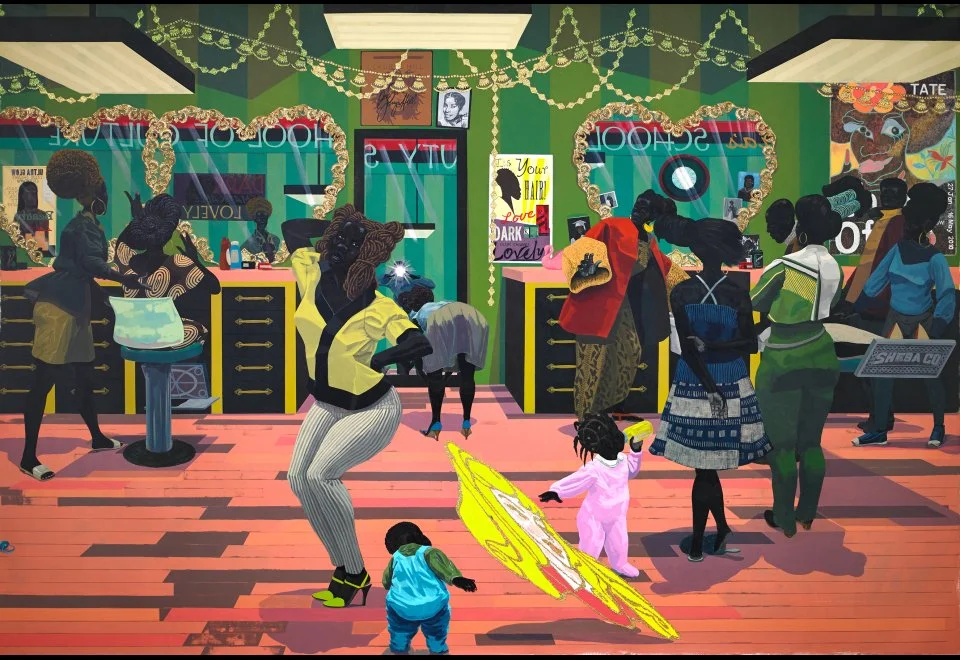
Kerry James Marshall, School of Beauty, School of Culture, 2012, acrylic and glitter on unstretched canvas will be on loan at Musée d’Art Moderne in Paris for the artist’s first exhibition in France this fall.
There is something slightly ridiculous about calling January the beginning of the year when you work in art. For us, the year begins after Labor Day. Everyone comes back to New York, galleries reopen at full throttle, museums unveil the exhibitions they’ve been saving, and the lull of August is replaced by previews, dinners, fairs, auctions, airport lounges and the realization that everyone you know has booked the same flights.
This fall is particularly unhinged.
New York starts with The Armory Show and Independent 20th Century. October belongs to Europe, with Frieze and Frieze Masters in London, followed almost immediately by Art Basel Paris. This November brings the big New York auctions as well as the debut of Frieze Abu Dhabi.
Then, because apparently nobody has suffered enough, the entire art world relocates to Miami in December. Between Labor Day and Art Basel Miami Beach, we effectively go on tour.
NEW YORK WAKES UP FIRST
New York begins aggressively. The Armory Show returns to the Javits Center in September, while Independent 20th Century makes its debut at Sotheby’s Breuer building, focused entirely on art made between 1900 and 2000. There is something wonderfully appropriate about a fair reconsidering twentieth-century art taking over Marcel Breuer’s former Whitney Museum.
The museum calendar may be even better. “Krasner and Pollock: Past Continuous” opens at The Met on October 4, bringing together more than 120 works and examining their careers side by side.
“Roy Lichtenstein: Like New” opens at the Whitney on October 11 and moves past the easy comic-book shorthand to look at his fascination with images being copied, enlarged, circulated and remade.
Then “Brancusi: The Artist and His Studio” opens at MoMA on October 25, with rarely lent works from the Centre Pompidou’s Atelier Brancusi coming to New York.
What excites me is that none of these sound like a greatest-hits tour. Krasner and Pollock ask us to reconsider two careers that history never treated equally. Lichtenstein suddenly feels very 2026, in a world where images are copied, cropped, memed and redistributed at the speed of light. And Brancusi reminds us that the way art is placed, lived with and seen can become part of the art itself. Famous names, yes. But hopefully not familiar stories.
Continental Carry-On Season
After that, everybody heads to Europe. Frieze London and Frieze Masters arrive first in mid-October, filling Regent’s Park with nearly 300 galleries. I’m skipping London - not because it’s a bad city for art, but because if I have to choose my October art-world pilgrimage and Art Basel Paris wins for me.
And Paris has made the decision very easy. “Kerry James Marshall: The Histories” at the Musée d’Art Moderne is his first exhibition in France, bringing together around 70 works, with some of them made just for this show.
The Fondation Louis Vuitton is devoting its major fall show to Gustave Fayet, the artist, collector and designer whose collection included extraordinary works by Van Gogh and Gauguin.
Then “Cézanne and Us” at the Grand Palais puts Cézanne into conversation with generations of artists who followed him, from Matisse and Mondrian to Joan Mitchell, Bridget Riley and Peter Doig. And at the Louvre, a major Zurbarán exhibition will have just opened.
This is what makes Paris during Art Basel so good. You can spend the morning looking at Cézanne’s influence across more than a century, the afternoon seeing what dealers believe matters now, and the next day stand in front of Zurbarán or Kerry James Marshall.
THE GREAT FALL MIGRATION
And then we keep going. November brings the major New York auctions, when the art market gets one of its clearest annual reality checks. This is where estimates stop being theoretical, guarantees get tested and we find out what collectors are actually prepared to spend when the objects become serious and the numbers multiply by several extra zeros.
This year the migration adds another stop: Frieze Abu Dhabi, making its debut in November at Manarat Al Saadiyat. The Gulf has been building cultural infrastructure at extraordinary speed, and adding a Frieze fair to the already formidable museum ecosystem around Saadiyat makes the region increasingly difficult to treat as a side trip. Then, just a couple of weeks later, Art Basel Miami Beach arrives in December. By then everyone will be exhausted, over-socialized and announcing that they are absolutely finished with art fairs while simultaneously asking what time the VIP opening starts.
There is a reason these twelve weeks matter beyond the people actually buying and selling art.
Fall is when museums make some of their biggest historical arguments, galleries place their most ambitious bets, auction houses test the appetite of collectors, and fairs compress an enormous international ecosystem into a handful of cities. You can learn a tremendous amount simply by watching what gets shown, what gets reconsidered, what sells, and what suddenly everyone cannot stop talking about.
January can keep the gym memberships. In art, the year starts now.