
The Groove 276 - A Tale of Two Art Collections
Welcome to the 276th issue of The Groove.
I am Maria Brito, an art advisor, curator, and author based in New York City.
If you haven’t done so, please subscribe here, to get The Groove in your inbox for free every Tuesday.
A Tale of Two Art Collections
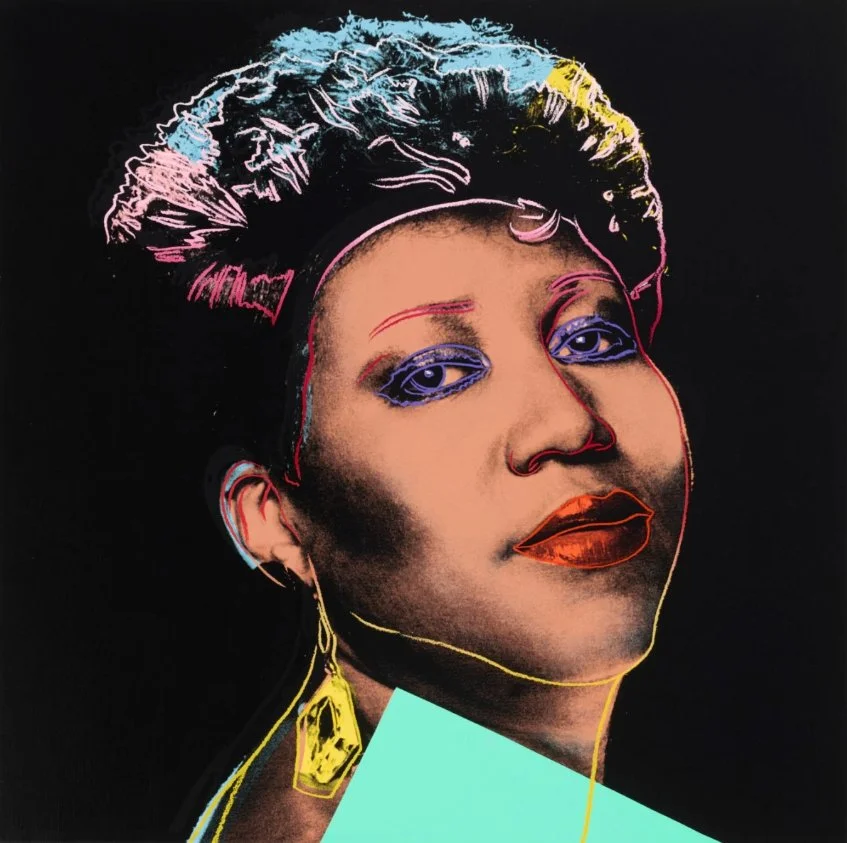
Andy Warhol, Aretha Franklin, circa 1986. Acrylic and silkscreen ink on canvas. 40 x 40 in. To be offered in the 20th Century Evening Sale as part of the Clive Davis sale during November 2026 at Christie’s in New York.
You can learn a great deal about someone by looking at what they hang on their walls: whether they have good taste, what they value, whom they remember, what they can’t let go of, and perhaps the most revealing, what they eventually can.
This week gave us two spectacular case studies. Peter Simon, the 77-year-old founder of Monsoon and Accessorize, is sending nearly 200 works from his collection to auction in London. Clive Davis, the legendary music executive who died in June at age 94, left behind a collection now coming to market in New York.
One man is clearing his walls while continuing to buy. The other left walls that read almost like a memoir. Together they raise a question I contend with constantly: what actually makes a great collection?
YOU CAN BREAK UP WITH A PAINTING
Simon made his fortune in textiles, and once you have that piece of information his collection starts talking about who he is as a person. He built Monsoon after traveling through Afghanistan and India, becoming fascinated with hand-blocked fabrics, embroidery, pattern and color. His walls eventually filled with Bridget Riley, Beatriz Milhazes, Hurvin Anderson and Warhol’s glittering Diamond Dust Shoes. His first art purchase was even a Kimsooja truck piled high with colorful fabric bundles. The eye that built the business also built the collection.
And now Simon decided he’s willing to sell. His collection numbers around 300 works; almost 200 are going to Christie’s. He said he wants to live with blank walls for a while, which would sound like the end of the story except that he recently bought a Lynda Benglis. Apparently even a collecting detox has its cheat days.
Collectors are surprisingly bad at letting go.
We discard clothes, renovate kitchens, change careers and occasionally spouses, but that painting bought in 2007 gets tenure.
Selling art feels like letting go of something extremely precious. Simon suggests something much healthier: maybe your eye changed because you changed. A collection shouldn’t become a monument to every decision you’ve ever made. You don’t owe every painting a lifetime appointment.
Clive’s Greatest Hits
Clive Davis’s walls tell a completely different story. Take Warhol’s Aretha Franklin. Aretha wasn’t merely a famous person Davis happened to collect: she signed with his Arista Records in 1980, and Davis helped engineer the remarkable next chapter of her career. When she wanted Warhol to create her portrait for the 1986 album Aretha, Davis already knew him. Eventually, one of those images ended up on Davis’s wall.
Then there is Warhol’s portrait of David Hockney. Hockney was Davis’s friend. Years later, Davis traveled to Hockney’s Normandy studio and sat for his own portrait. So Davis owned a Warhol painting of Hockney, Hockney painted Davis, and Warhol painted Aretha, whose career Davis helped shape. Six degrees of Clive Davis, except there’s no separation.
This isn’t the kind of value an auction estimate can capture. Warhol’s Aretha Franklin is estimated at $2–3 million, but in Davis’s house it meant something beyond price, something no other owner could reproduce. Provenance tells us where an artwork has been. A personal collection can tell us where a person has been.
The best work for your collection isn’t necessarily the most expensive or canonical work you can afford. Sometimes it’s the one that couldn’t belong to anyone else.
200 vs. 16
And now comes the part collectors don’t particularly enjoy hearing. Simon’s nearly 200 works carry a high estimate of £127 million. Four months ago, sixteen works from S.I. Newhouse brought $630.8 million in New York. His Pollock alone made $181.2 million. Brancusi’s Danaïde made another $107.6 million. Two objects comfortably surpassed the high estimate of Simon’s entire sale.
The lesson isn’t that Newhouse had better taste but that the art market isn’t Costco. More is not necessarily more. At the very top, value becomes ferociously concentrated in exceptional objects: the breakthrough painting, the rare sculpture, the work with impeccable provenance, the thing important enough to make several billionaires forget whatever budget they had five minutes earlier.
So perhaps these collections are measuring three entirely different things. Simon shows us that collecting can be edited. Davis shows us that collecting can become autobiography. Newhouse shows us that when the market keeps score, exceptional quality beats accumulation.
There is no single formula for a great collection, but there is one mistake I see constantly: confusing more art with a better collection.
Buy what tells your story. Let your eye change. And when a truly great object appears, perhaps buy one of those instead of five things you merely like.