
The Groove 277 - The Art World Has Commitment Issues
Welcome to the 277th issue of The Groove.
I am Maria Brito, an art advisor, curator, and author based in New York City.
If you haven’t done so, please subscribe here, to get The Groove in your inbox for free every Tuesday.
The Art World Has Commitment Issues
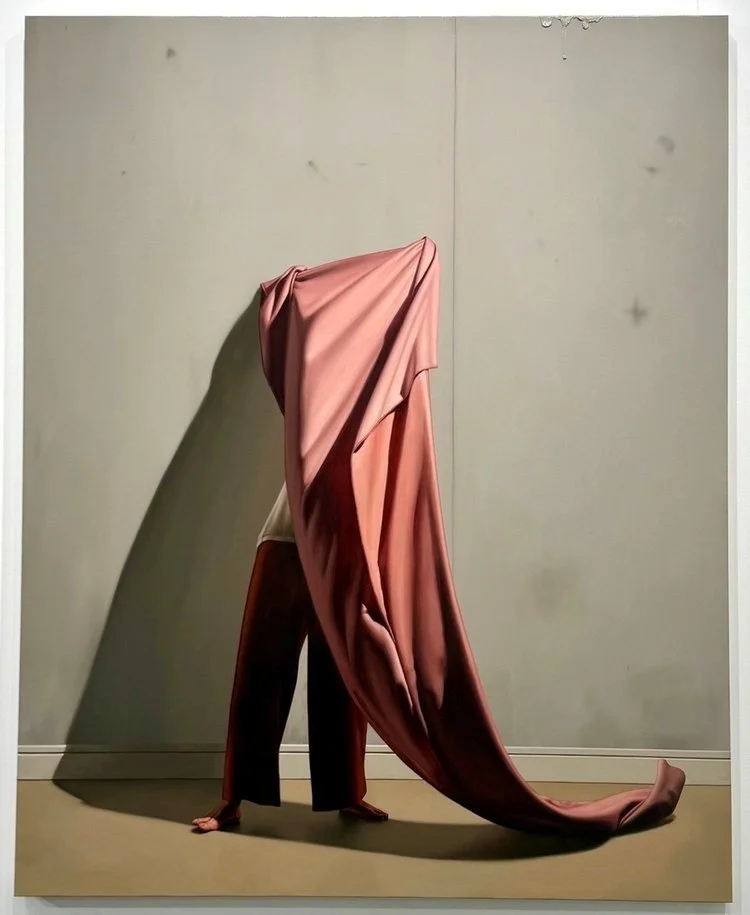
Dhewadi Hadjab, Untitled, 2026. Oil on canvas. Seven paintings of this series were presented and sold by Mennour during the Armory Show last week in New York.
There are a million reasons people don’t commit. Maybe the timing isn’t right or they’ve been burned before, perhaps they’re perfectly happy having fun without making things official. Or the most dangerous thought of: what if something better comes along?
Carrie Bradshaw, our Gen X heroine from Sex & the City, spent six seasons trying to solve this problem. At one particularly painful lunch, after Mr. Big announced that he was engaged to Natasha, she demanded: “How can you be engaged? You have a problem with commitment, remember?”
I’ve been thinking about Carrie because the art market seems to be dating like Mr. Big.
The art market isn’t celibate. Far from it. At The Armory Show last week, hundreds of works sold on opening day. A JoanMitchell changed hands for more than $2 million. Seven paintings by Dhewadi Hadjab sold for $110,000 each.
Buyers are out there. They’re looking. They’re flirting. They’re occasionally going home with something. They just aren’t equally willing to put a ring on everything.
Let’s dig deeper around the dating conceit:
FIRST DATE, LOW STAKES
At the Armory, roughly two-thirds of the 245 opening-day transactions reported to Artnet were below $25,000. Paintings at $3,500-$8,500 sold out. Works around $18,500 moved. Derrick Adams sold from $8,500 to $38,500. The data isn’tcomprehensive because only 55 of the fair’s 241 exhibitors reported, but they offer an intriguing picture of where saying yes currently feels easiest.
Because $10,000 or $20,000 can still be a love affair. You see the thing. You love the thing. You can afford the thing. You don’t necessarily need to know what the artist’s auction record was in 2022 or construct an investment thesis around where the market will be in five years. Sometimes a painting can simply make your heart beat faster. How refreshing.
At the opposite extreme, commitment can become easy again. Michael Rosenfeld sold a Joan Mitchell for more than $2 million. That’s not an impulse purchase, obviously, but the proposition is unusually clear: major artist, finite supply, enormous institutional history, deep international collector base. Apparently the art market will still get married. It just wants to know who it’s marrying.
IT’S COMPLICATED
The trouble starts somewhere in between. Put $300,000 or $500,000 on a perfectly good work by an artist whose auction market has softened, and romance suddenly gives way to background checks.
What did the last three sell for? What’s available privately? Why is the gallery asking $600,000 when a comparable work made $375,000 at auction? How many paintings does this artist make every year? And… there it is again: what if something better comes along?
This is where today’s market feels most different. During a rising market, momentum always supports conviction. If prices had been climbing for three years and everybody wanted the artist, buying the merely good example could still feel safe. The market effectively whispers, Don’t worry, he won’t change. We all know how that relationship typically ends.
Now buyers want a reason to commit. The work either has to be exceptional or the price has to make sense. Preferably both. The middle isn’t necessarily short of money. It’s short of conviction. And that’s much harder to fix with another VIP dinner.
THE PRENUP GOT MORE EXPENSIVE
Auction houses have their own version of relationship economics. Christie’s and Sotheby’s now charge buyers 28% on the first $2 million of hammer price in New York, 22% on the portion between $2 million and $8 million, and 15% above $8 million. In other words, the percentage gets smaller as the relationship gets more serious
Experienced collectors know perfectly well what a buyer’s premium is. But the interesting part isn’t explaining the fee. It’s asking what the fee structure tells us. Auction houses compete ferociously for the great $20 million, $50 million and $100 million consignments, because those are the works that bring bidders, headlines and entire evening sales to life. Meanwhile, the economics of handling less expensive art, which includes cataloguing, specialists, photography, storage, insurance, and marketing don’t shrink proportionately with the hammer price.
Which makes the current market almost comically consistent. Buyers are becoming choosier. Auction houses are becoming choosier. Everybody wants the extraordinary object. Everybody is less enthusiastic about carrying the cost of the merely decent one.
The art market hasn’t fallen out of love. It has simply become much harder to marry.