
The Groove 272 - New Money, Old Masters
Welcome to the 272nd issue of The Groove.
I am Maria Brito, an art advisor, curator, and author based in New York City.
If you haven’t done so, please subscribe here, to get The Groove in your inbox for free every Tuesday.
WHEN ART COLLECTING GETS SERIOUS
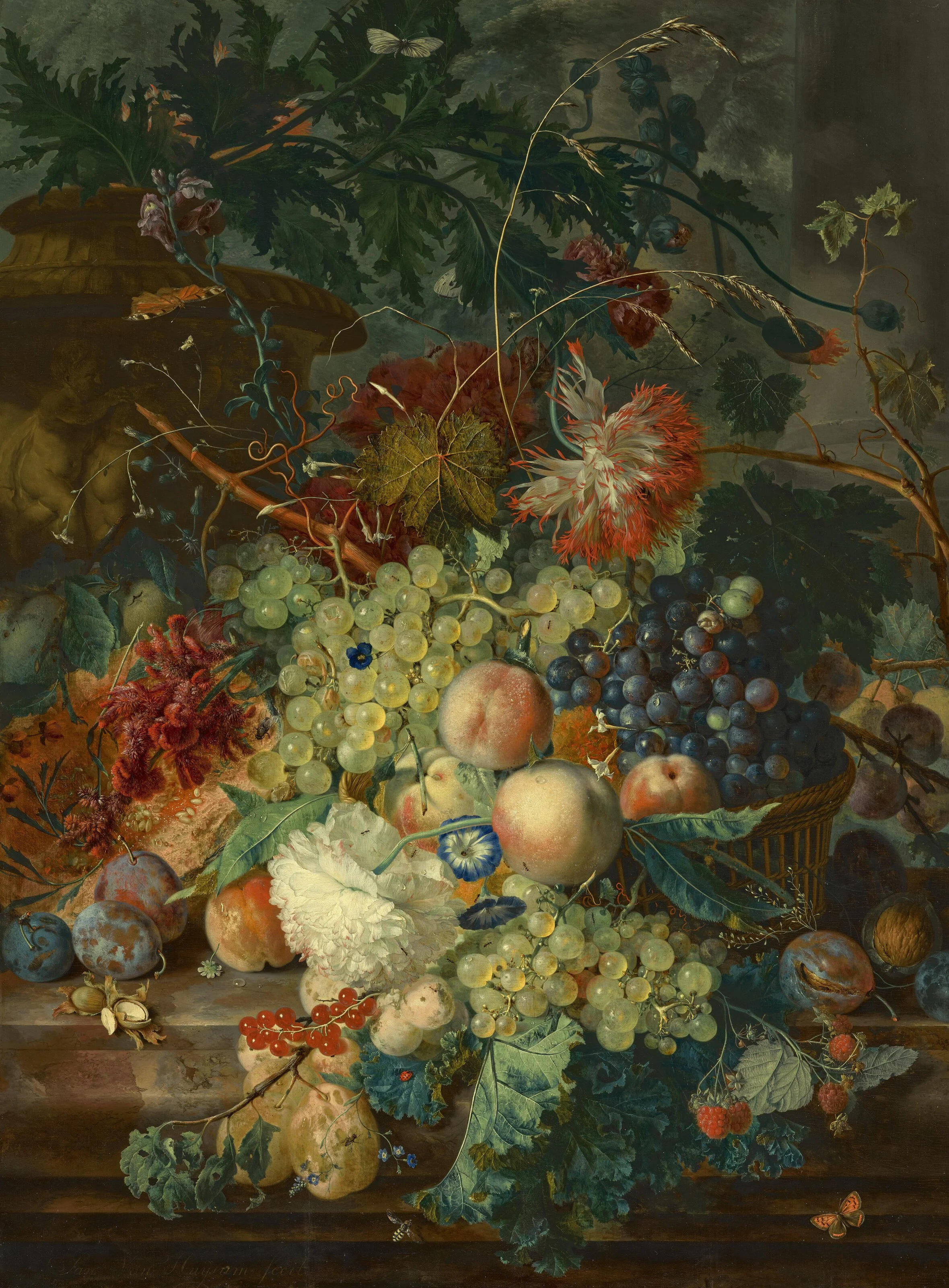
Jan van Huysum, Peaches and grapes in a wicker basket, oil on panel. Sold at Christie’s in London last month for $8.65 million.
Something has been shifting in the rooms where serious art gets bought and sold. In the last six months, four different people have asked me for old masters.
At Christie’s London last month, two still lifes by Jan van Huysum, an obscure Dutch painter born in 1682 who famously delayed a commission for an entire year because he refused to paint a yellow rose until the right one bloomed, sold for $8.65 million and $7.35 million, both records for the artist. Then an anonymous 17th-century vanitas, catalogued simply as “Dutch School” and estimated at just $106,000, sold for $572,500. At Sotheby’s, roughly 20% of buyers in its Old Masters sale were completely new to the auction house.
No, the world hasn’t suddenly become nostalgic. Something else is happening.
The Contemporary Hangover
For more than a decade, the market behaved as though history had stopped. Every studio visit promised “the next Basquiat.” Every Yale MFA show supposedly hid tomorrow’s star. Galleries expanded, fairs multiplied, and collecting began to resemble venture capital with paint.
Then supply exploded. There are more artists, more galleries, more fairs, more advisors, more biennials, and more art schools producing talent than at any other moment in history. That’s exciting, but it has also created an uncomfortable side effect: much of contemporary art has begun to look surprisingly similar. Walk enough fairs and you’ll notice the same muted abstractions, the same psychologically ambiguous figures, the same earthy palettes, the same visual language recycled with slight variations.
When everything is contemporary, nothing feels contemporary anymore.
The market didn’t simply cool off; it became exhausted. Collectors aren’t just reacting to prices. They’re reacting to repetition.
Why the Past Suddenly Feels New Again
Ironically, many of the buyers driving this shift come from technology. They built fortunes creating the future, yet they’re increasingly drawn to objects that have already survived three or four centuries. After a decade of being obsessed with disruption and after watching NFTs implode, they’re discovering something remarkably attractive: permanence.
But this isn’t really about Dutch still lifes. It’s about craftsmanship, scarcity, and history. A Caravaggio tondo, a Spanish Baroque portrait, or an early Renaissance panel offers something contemporary art often can’t: the certainty that history has already done the editing. The artist has survived fashions, politics, changing tastes, and generations of collectors.
The most interesting part is that these buyers aren’t specialists. They move effortlessly between centuries. A Rubens workshop painting can hang next to a Rashid Johnson. A Madonna on gold ground can share a wall with a Wade Guyton. To them, quality matters more than chronology.
The Longest Condition Report Ever Written
Here’s the irony almost nobody talks about: below the trophy tier of Rembrandts and Vermeers, many Old Masters are remarkably affordable. A beautiful 17th-century painting can cost the same as a mid-career contemporary artist fresh from an art fair. The difference is that nobody is graduating from Yale next spring and becoming another Pieter Claesz. The supply is closed forever.
None of this means contemporary art is over. Some of the greatest artists alive are working today, and every Old Master was once an unknown living artist. But right now, contemporary art’s biggest challenge isn’t quality. It’s abundance. Too many choices. Too much work competing for the same attention.
Perhaps what we’re witnessing isn’t an Old Master revival at all. It’s the return of patience. Great art doesn’t become great because the market declares it so on a Tuesday afternoon. It becomes great because it survives.
History is simply the longest condition report ever written.
And lately, more collectors seem willing to trust it.