
The Groove 254 - The First 25 Years: 25 Works That Defined the Century (So Far)
Welcome to the 254th issue of The Groove.
I am Maria Brito, an art advisor, curator, and author based in New York City.
If you haven’t done so, please subscribe here, to get The Groove in your inbox for free every Tuesday.
THE FIRST 25 YEARS: 25 WORKS THAT DEFINED THE CENTURY SO FAR
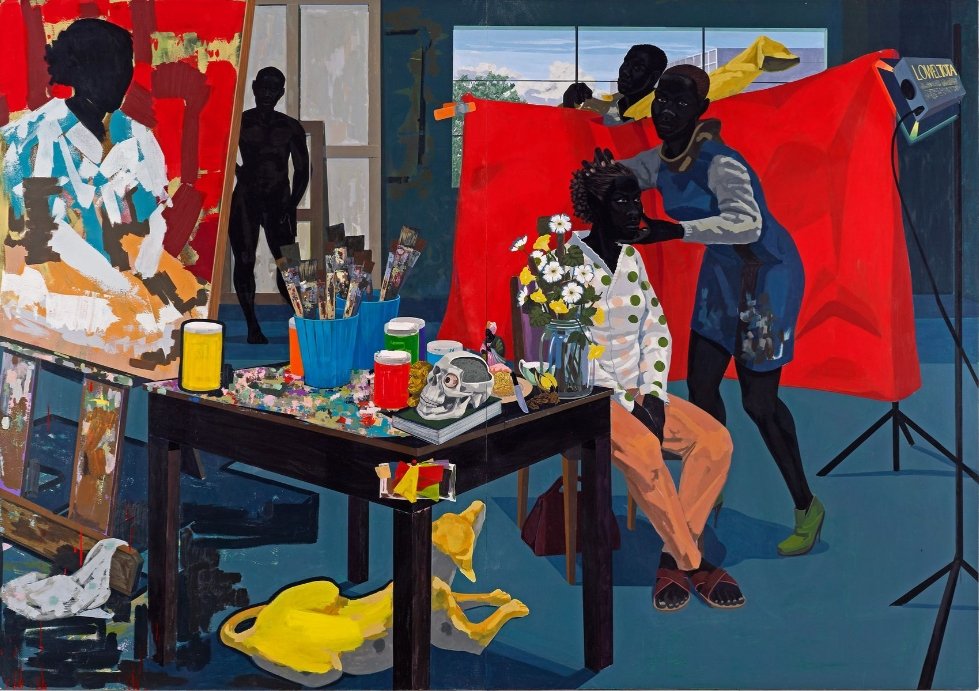
Kerry James Marshall, Untitled (Studio), 2014. Acrylic on PVC panel. Metropolitan Museum of Art, New York
The twenty-first century arrived as I arrived in New York - a city I’ve called home for a quarter century and the place that gave me a live, unrepeatable art education: museums and galleries first, then studio floors, back rooms, auction previews, collectors’ homes, and the best clients and colleagues anyone could ask for.
Last week, speaking with a gallerist friend about this newsletter’s entry right after Art Basel Miami Beach, on who gets to decide what counts as art, we landed on a simple truth: the “establishment” resists whatever threatens to make its old ideas irrelevant.
This isn’t a treaty; it’s a field report from twenty-five years on the ground, seeing and selling a lot of art, traveling the world and personally knowing many of the artists on this list.
What follows is my “25 for 25” works that defined the first quarter of this century.
The through-line is unmistakable: anxiety and acceleration, technology and disinhibition, social and political turmoil, cultural upheavals, and the rise of identity politics, countered, always, by a stubborn return to rigor.
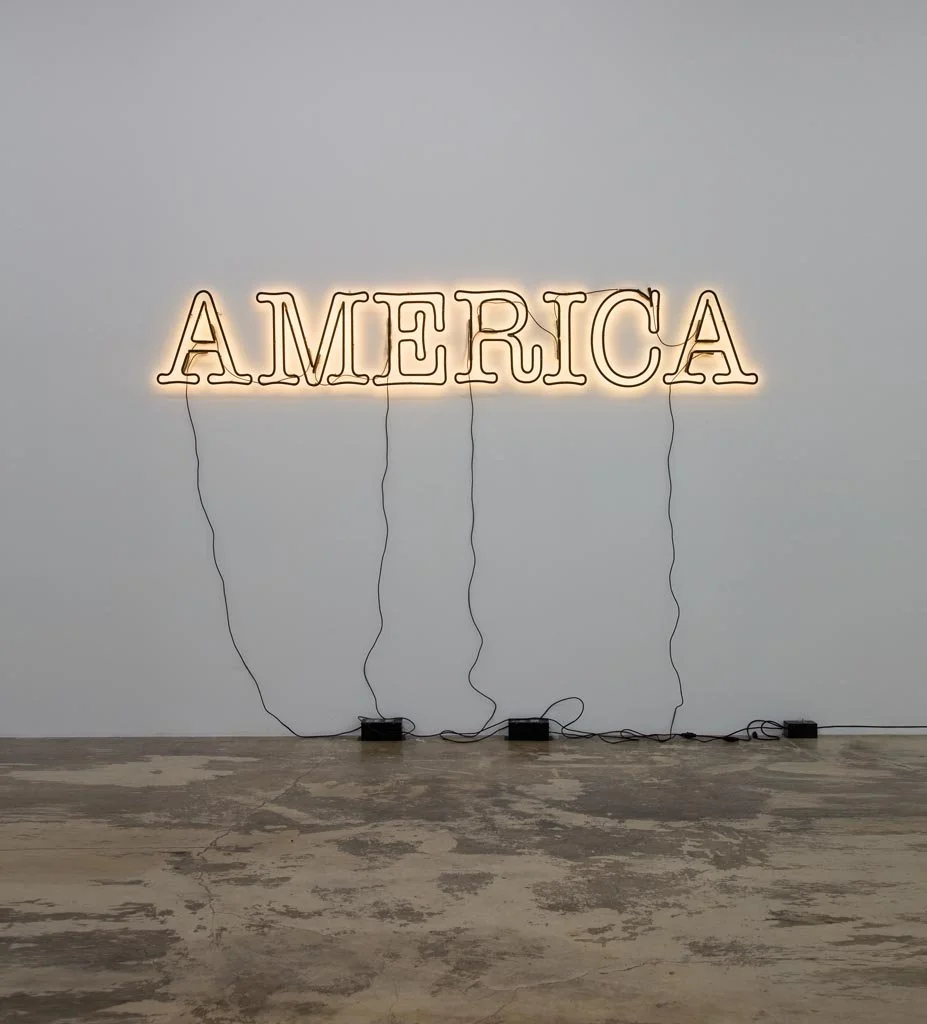
Glenn Ligon, America, 2008. Neon sign and paint, Ed. AP. Rubell Museum
1. Richard Prince — Nurse paintings (2002–2006)
Pulp erotica laundered through high painting. Appropriation becomes brand strategy; teaching the century to price aura over authorship.
2. Olafur Eliasson — The Weather Project (2003)
A fake sun that made strangers lie down together. Environmental playhouse predicts climate anxiety and the museum as town square.
3. Julie Mehretu — Stadia II (2004)
Diagram, protest, fireworks, then abstraction. She maps globalization’s churn and proves “pure painting” can carry geopolitical charge.
4. Anish Kapoor — Cloud Gate (2004)
A mirrored city turns itself into the art. Public space and selfies before-selfies: how sculpture became an urban logo.
5. Christo & Jeanne-Claude — The Gates (2005)
Temporary orange river through Central Park. Logistics as poetry and mobilizing the biggest city in the United States without selling anything.
6. Damien Hirst — For the Love of God (2007)
A real human skull priced like a super-yacht: 32 platinum plates set with 8,601 diamonds of VVS to flawless quality, weighing a total of 1,106.18 carats. Memento mori meets luxury goods. Death and bling as the era’s operating system.
7. Mark Bradford — Bread and Circuses (2007)
Billboard shreds and civic maps fused into a present-tense history painting: urban economies, racial geographies, and Roman spectacle in one surface for today.
8. Glenn Ligon — AMERICA (2008)
Neon that both declares and obstructs. Visibility and erasure in the same breath; a country as a flickering sign. More relevant than ever.
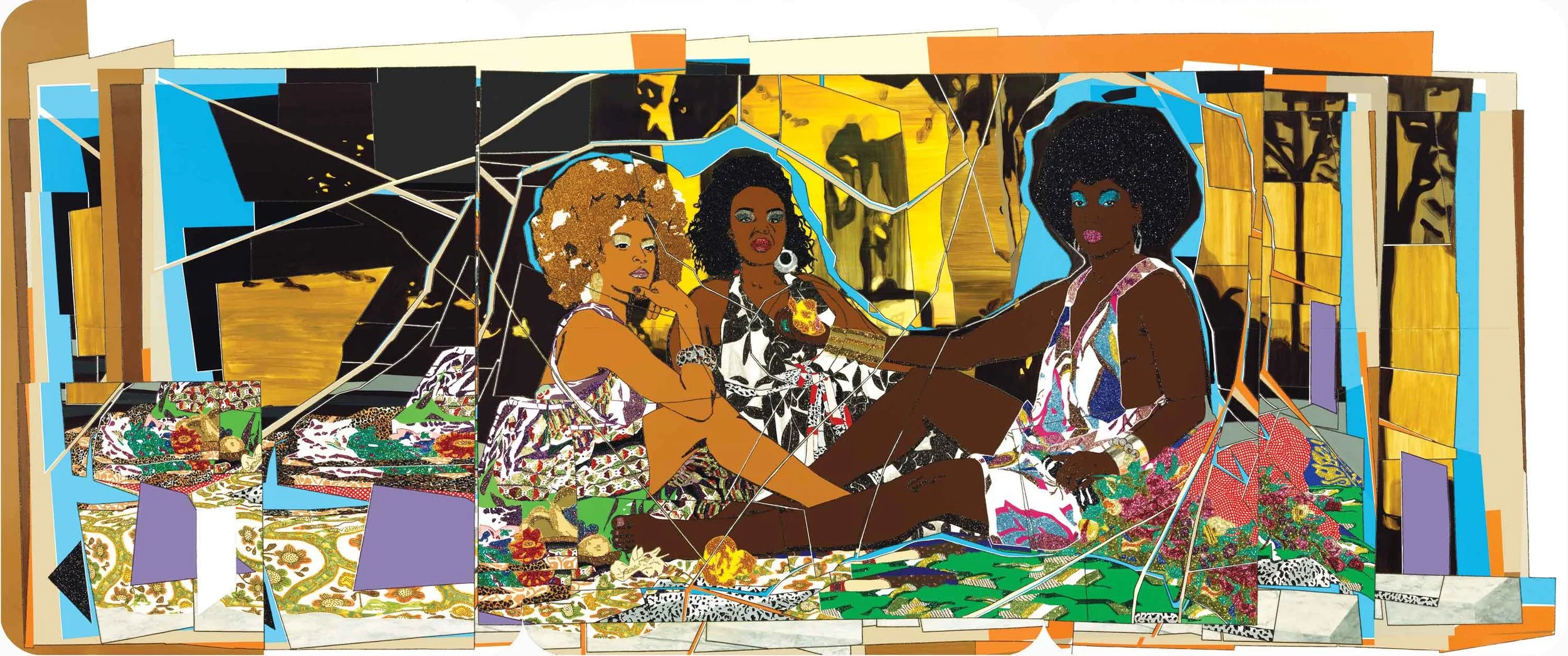
Mickalene Thomas, Le Dejeuner sur l’herbe: Les trois femmes noires, 2010. Rhinestones, acrylic, and enamel on wood panel.
9. Pipilotti Rist — Pour Your Body Out (7354 Cubic Meters) (2008–09)
MoMA’s atrium becomes a soft-core dreamscape. Immersion before “immersive” turned into a business plan.
10. Mickalene Thomas — Le Déjeuner sur l’Herbe: Les Trois Femmes Noires (2010)
Manet rewritten with rhinestones and saturated colors. Art history revision not as complaint but as glamour, and a new power image for Black femininity.
11. Christian Marclay — The Clock (2010)
A 24-hour film cut to real time. Attention, montage, and the tyranny of seconds. This is calendar as cinema.
12. Marina Abramović — The Artist Is Present (2010)
A chair, a gaze, and a line around the block. Performance becomes pilgrimage; intimacy scales to celebrity.
13. Ai Weiwei — Sunflower Seeds (2010)
Millions of handmade porcelain seeds. The geopolitics of labor disguised as minimalism. Participation meets prohibition.
14. Random International — Rain Room (2012)
Weather that parts for your body. Engineering as spectacle, a prototype for the “experience economy” the art world can’t quit.
15. Yayoi Kusama — Infinity Mirrored Room—The Souls of Millions of Light Years Away (2013)
Endless points of light, endless queues. A sincere meditation on infinity that has also fueled the Instagram era.
16. Kerry James Marshall — Untitled (Studio) (2014)
The studio as sovereignty. Mastery of oil paint and Black subjectivity placed squarely inside Western art history.
17. Kara Walker — A Subtlety, or the Marvelous Sugar Baby (2014)
A sugar sphinx in a doomed refinery. Race, labor, and commodity worship while site, smell, and scale do the heavy lifting.
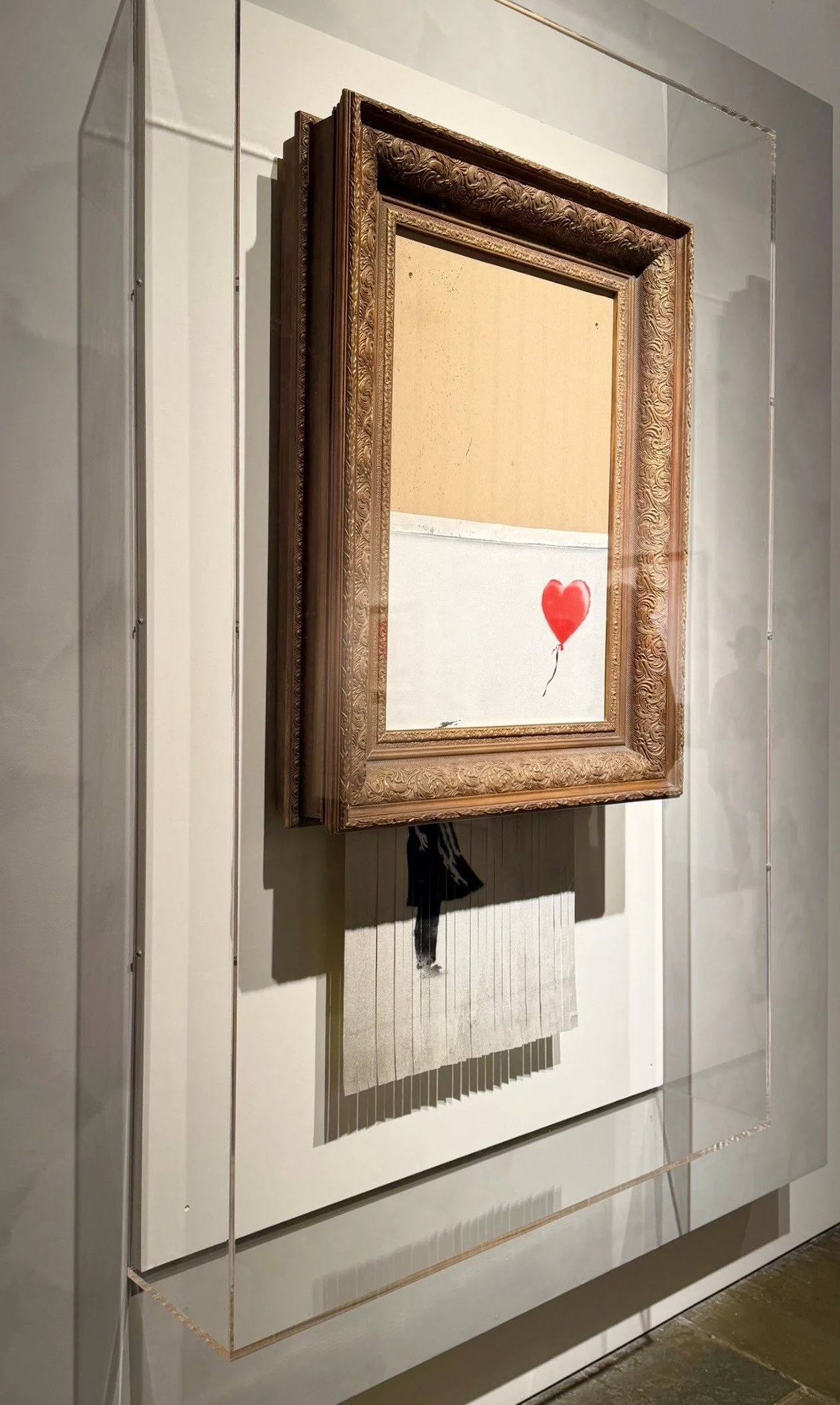
Banksy, Love Is in the Bin (2018). Spray paint, acrylic paint, canvas, cardboard, vintage frame.
18. Marlene Dumas — Great Men (2014– )
Ink portraits of public men who are saints, sinners, and everything in between. Masculinity examined like a water stain: diffuse, indelible.
19. David Hammons — Oh Say Can You See (2017)
A national anthem you have to look through. Flags, scrims, and distance show who gets seen, and by whom.
20. Banksy — Love Is in the Bin (2018)
A painting shreds itself live during an auction sale. The market becomes the medium.
21. Kehinde Wiley — Portrait of President Barack Obama (2018)
State power framed by botany and pattern. Presidential portraiture reset for a new century.
22. Maurizio Cattelan — Comedian (2019)
A banana, some tape, and a global argument. The dumbest object makes the sharpest point: price is performance.
23. Beeple — Everydays: The First 5000 Days (2021)
JPEG as $69.3M lot. Whatever you think of the images, a parallel market with real capital arrived overnight.
24. Rashid Johnson — Anxious Men series (2015 – )
Evolving the scrawled, wide-eyed heads of his Anxious Men (2015–), Johnson gives the 2010s–2020s a true glyph. The “Bruise Paintings” and the “Surrender Paintings” followed. Their faces aren’t branding; they are seriality: repeatable, variable, and instantly legible like Basquiat’s crown or Haring’s radiant baby. They compress private dread and public pressure into one image, which is why museums show it and serious collectors live with it.
25. Refik Anadol — Unsupervised (2022–23)
AI dreams a museum’s archive back at us. A seductive debate about authorship, datasets, and whether machines compose wonder or just rearrange it.
These works didn’t live in studios alone. They moved through galleries that took risks, museums that built arguments, auction houses that stress-tested value, feeds that amplified images, and a public who answered back.
The art world in this century’s first 25 years wasn’t a ladder, but a feedback loop of artists, dealers, curators, collectors, and audiences editing one another in real time.
That’s the point going forward: the art world is not a monolith but a living network, where ideas change as they circulate. When one part moves-taste, tech, or capital-the others recalibrate. That’s the real structure: iterative, adversarial, interdependent. What endures are the pieces that keep producing consequences wherever they land: on a wall label, in a sale room, on a feed, in a syllabus. Those are the ones that will still matter in 2050.