
The Groove 255 - The Art Market Vibe-Shift Index 2026
Welcome to the 255th issue of The Groove.
I am Maria Brito, an art advisor, curator, and author based in New York City.
If you haven’t done so, please subscribe here, to get The Groove in your inbox for free every Tuesday.
THE ART MARKET VIBE-SHIFT INDEX 2026
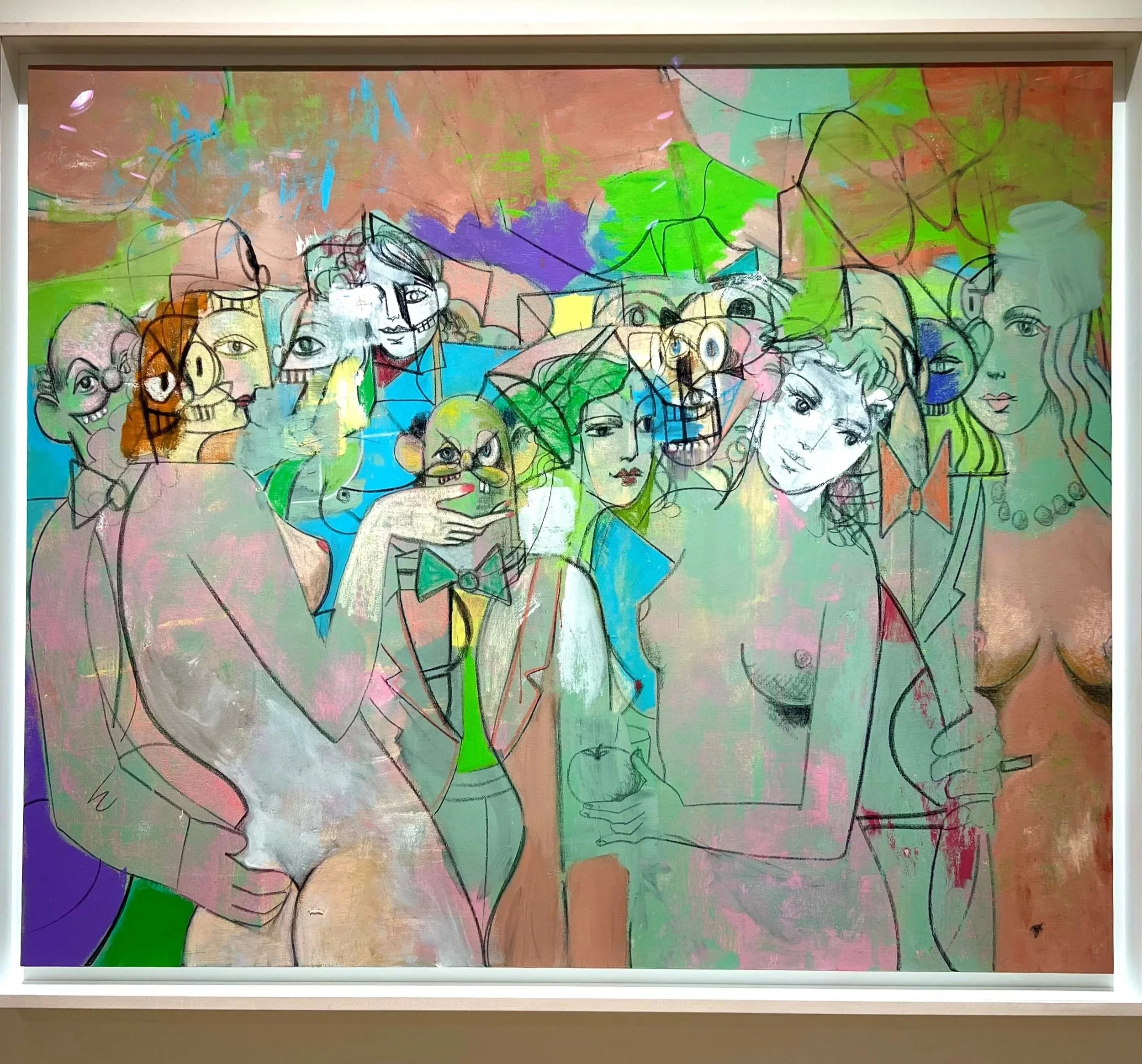
George Condo. Abstract Conversation, 2010. Acrylic, charcoal and pastel on linen.
Happy New Year! Where is the art market heading in 2026?
Attention remains finite and fragmented and discernment is scarce. The real question for this year is not “What’s hot?” It’s instead, “What has the infrastructure, lineage, and stamina to matter?”
Below are some of the currents I see shaping the year: what’s peaking, what’s plateauing, what’s building underneath, and how serious collectors should move now.
Peaks & Fades: Spectacle vs. Shelf Life
The spectacle economy will keep throwing confetti. You’ll see more engineered “moments” designed for velocity with clever hardware, algorithm bait, and one-liner concepts. They’re perfect for fairs and feeds because they resolve instantly; that’s also why their half-life is short. Hardware ages, jokes date, and once the clip circulates, the work has to stand on something more lasting than shock value.
At the other end is sameness: a glut of big, handsome abstractions with identical comforting palettes and the same all-over brush grammar. It photographs well; it rarely evolves. When dozens of studios produce canvases that dissolve into the same surface, you’re not looking at a movement but at a passing trend. Expect selective demand, waitlists, and a widening price gap between artists who deepen their language and those repeating inventory.
The edit that matters in 2026 is formal, not moral. Ask where the picture almost breaks: edge control, color logic, compositional risk. If the answer is “nowhere,” the work may be fine décor but it won’t carry a collection.
Plateaus: Where the Floor Holds
The most resilient part of the market right now is mid-career and carefully paced: artists who have lived through multiple cycles, tightened their language, and can fill a room without repeating themselves. Prices are rational, placement is intentional, and museums are quietly doing the work with group shows, smart loans, and focused retrospectives. This is where conviction compounds.
Scale is recalibrating with taste. After a decade of billboard canvases, small-to-medium works with high “jewel pressure” are winning. Pay attention to dense drawings, rigorous paintings, and intimate sculptures that read like sentences, not shouts. They conserve well, live beautifully on domestic walls, and still have bones to get passed down generations.
Expect a tighter relationship between museums and private collections: curators looking for lenders with depth, not breadth; collectors prioritizing works that stand up under institutional light. The floor here is made of craft, pacing, and evidence like catalogues raisonnés, exhibition histories, and artworks that don’t need a press release to speak for it.
Undercurrents: What’s Quietly Building
I see a lot of Latin America’s build-out. More booths on fair maps, stronger programs, sharper installations, revival of estates and discovery of the global south’s talent. The question isn’t visibility but building the proper scaffolding. Careers are built on cash-flow for production, catalogs, loans, and time between bodies of work. Watch for galleries co-producing shows across cities, sharing shipping, and managing supply. That’s how a “moment” becomes a chapter.
A return to ’90s systems without cosplay. After years of confessional maximalism, a cooler register is back: diagrammatic painting, list-logic, serial sculpture, text used as structure. The good version has stakes and is form that inspires thought. The weak version Xeroxes fonts and vibes from the decade before last. Maybe even photography can have a comeback.
Identity stopped working as a label and started carrying weight when it was built into form. This is the time when biography shows up as strong narrative with a compelling use of material, scale, palette, and structure rather than as a headline.
Your filter: if you can swap the name and nothing breaks, think twice before praising or (gasp) buying.
The System, Not the Season: Where It’s Heading
Studios are slowing down, not stalling. Expect fewer shows and tighter arguments. The artists who matter in 2026 won’t scale output; they’ll deepen language.
Museums will trade spectacle for scholarship. We’ll see more collection rotations with sharp theses, more research-driven retrospectives, more catalogs that actually close gaps. Galleries will consolidate and co-produce across cities and pace supply. Advisors will act less like personal shoppers and more like editors. Auction houses will keep functioning as the city’s “museum with prices,” but the real canon still gets built by essays, exhibitions, and circulation.
Pricing should keep normalizing. The mid-tier stays strongest; small-to-medium works with high “jewel pressure” outperform billboards. Provenance and institutional touchpoints move numbers more than hashtags. Discovery will remain digital; conviction will stay analog.
And for collectors: don’t buy what the feed rewards this week, buy what the next syllabus will need.