
The Groove 256 - Redrawing the Labels: Emerging, Mid-Career and Blue-Chip Art In 2026
Welcome to the 256th issue of The Groove.
I am Maria Brito, an art advisor, curator, and author based in New York City.
If you haven’t done so, please subscribe here, to get The Groove in your inbox for free every Tuesday.
REDRAWING THE LABELS: EMERGING, MID-CAREER AND BLUE-CHIP ART IN 2026
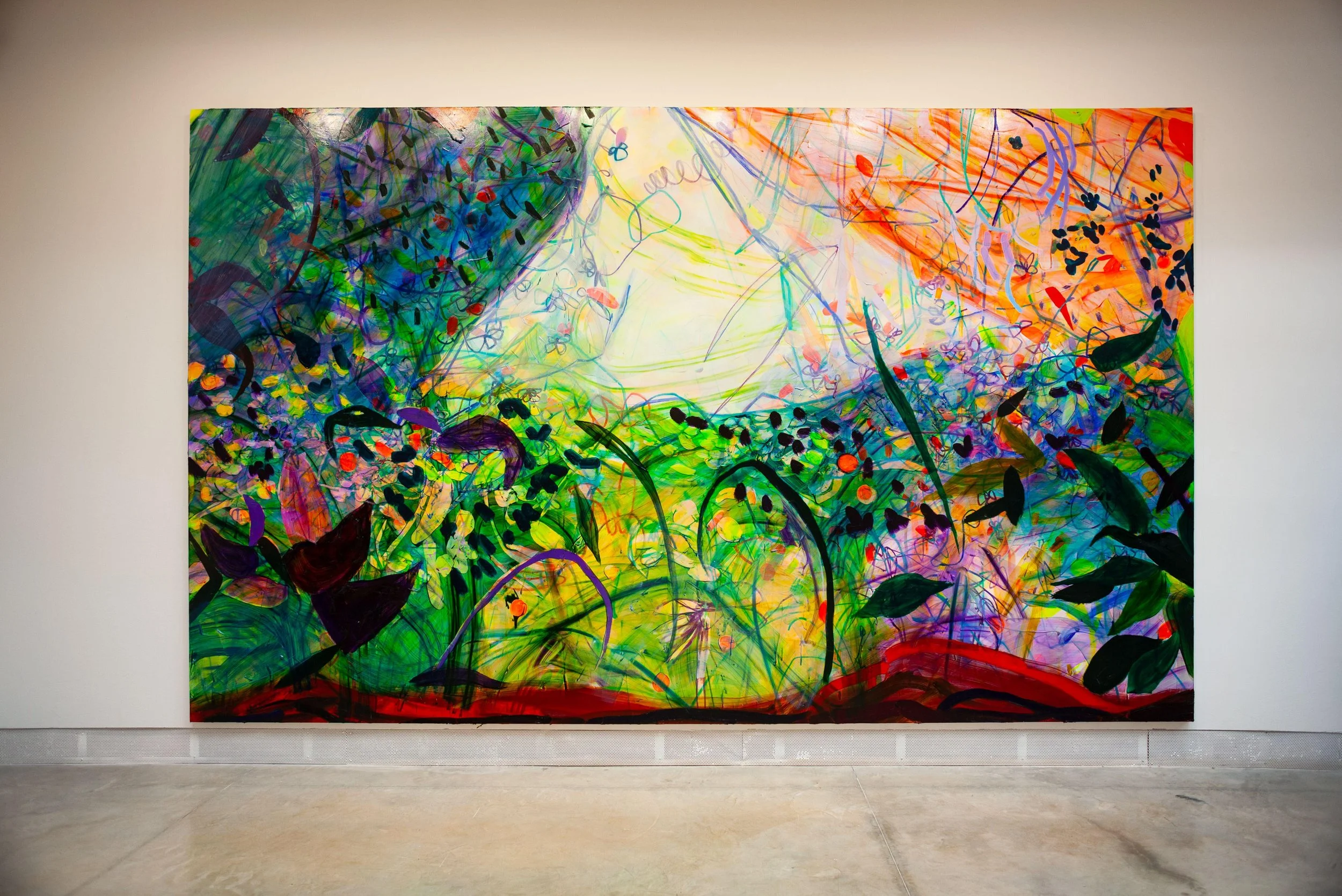
Jadé Fadojutimi’s canvas at the main pavilion of the 59th Venice Biennale in April, 2022. Photo: Giuseppe Anello.
When I opened my art advisory 17 years ago, the phrase “emerging artist” meant someone who was in the first 5-7 years of their careers, a first gallery show, sub-$10k prices, and years of proving ground ahead. “Mid-career” meant two decades of work, representation by a solid gallery, some museum acquisitions and a couple of monographs. “Blue-chip” meant several museum retrospectives, catalogues raisonnés, and a market that didn’t panic in recessions. Only “blue-chip” has remained more or less the same since.
Now, with Instagram visibility, fair circuits, and mega-gallery consolidation compressed time, artists can go from MFA to the Venice Biennale to mega-gallery in a handful of seasons. While others work brilliantly for 20 years and only then enter the conversation.
Pablo Picasso is a reminder that velocity isn’t new, only the pipeline is. By 26 he’d closed two stylistic chapters (Blue and Rose) and detonated Cubism with Les Demoiselles d’Avignon (1907). But that acceleration sat on a decade of obsessive practice and a dealer (Kahnweiler) who engineered part of his ascent.
Today’s “surges” look different, but in the long term the underlying test hasn’t changed: can the work carry its own weight once the hype fades?
In 2026, think of these tiers not as ages, but as risk profiles tied to proof. What’s been tested, where, and for how long?
EMERGING: Early Proof Under Bright Lights
“Emerging” no longer means “cheap,” “untested,” or working with a shoestring budget. It means first serious evidence under real scrutiny. Think coherence across bodies of work, not one viral show. Add to that the support given by credible champions: curators, writers, big collectors, and galleries that filter and come with deep pockets too.
There are many young artists who are all excellent, and while I could cite hundreds, I’d like to highlight Jadé Fadojutimi. She is the textbook of compressed ascent: MA in 2017, institutional attention within a couple of years, Venice Biennale in 2022, and representation by Gagosian that same year. Auction fireworks started in 2020 with one of her paintings selling for $378,000 and ten months later for $1.1 million. But the educational piece is why the work traveled: she has a unique but recognizable language in abstraction with color, speed, and edge that keeps mutating rather than posing.
Two more “emerging” realities worth knowing:
• Late bloomers exist. Etel Adnan entered the market late, but the paintings had decades of thinking behind them. “Emerging to market” ≠ “emerging as an artist.”
• Canon without a market exists. Hilma af Klint reconfigured art history, but there’s nothing to buy. Market labels are not the same as cultural impact.
Don’t mistake velocity for inevitability. Pay attention to pacing (how often and why the work appears), writing (who is making the case), and evolution (can you see the next move from the last three shows?).
MID-CAREER: The New Sweet Spot for Quality
This is the tier where the ups and downs of a career compound and balance out. Mid-career now means a decade-plus of production, multiple institutional looks, and a language that holds together across scale. Prices are rationalizing post-boom; supply is better edited; the best works are persuasive and compelling.
Mid-career is where you get the highest object-quality per dollar right now. Look for A-period examples (not filler), serious writing (monographs, not just press), and works that hold their center across rooms and years. These are a handful of excellent mid-career artists:
• Dana Schutz: Painterly invention as argument, not garnish; composition is the engine. Look for dense, structurally resolved canvases (roughly 2011–2016 and other “all-systems-go” periods), not late derivations of headline works.
• Carol Bove: A very different take on sculpture that is completely improvisational. Rolled/creased steel, wood and brass with smooth surfaces coated with sharp colors giving toughness and elegance all made in her studio through physical manipulation. Look for confident “fold” forms from the mid-2010s onward, and site-responsive ensembles that hold both outdoors and in.
• Mickalene Thomas: sustained re-staging of modernist compositions through rhinestone, wood veneer, enamel and glamorous Black women inside beautiful patterned interiors rooted in art history. Decade after decade, the argument deepens and museums keep showing her work.
BLUE-CHIP: A Dossier, Not a Vibe
Blue-chip isn’t defined by price; it’s defined by survival across cycles. Think retrospectives, catalogues raisonnés (or well-advanced ones), repeated museum loans, and bid depth in both good and bad years. The market can wobble; dossiers don’t. For example:
• Kerry James Marshall: textbook dossier with a deep historic argument, institutional recognition in top institutions around the world, and market depth built the slow way.
• Yayoi Kusama: multi-decade practice, museum ubiquity, and a primary and secondary market paced for longevity.
• Gerhard Richter: serial reinvention inside a coherent worldview; literature and museums as thick as it gets.
• Jenny Saville: a painter’s painter with institutional weight and a market that recognizes craft at scale.
If the scholarship, institutional record, and secondary behavior all say the same thing over decades, you’re in blue-chip territory regardless of the artist’s age or the week’s headlines.
What does this all mean today?
Great collections aren’t built by chasing velocity; they’re built by pacing, stewardship, and taste with a memory. Spend patience like capital. Back artists whose language is still widening at all levels - where there’s exhilaration and promise at the emerging space, the object carries its own weight at the mid-career one, and the blue-chip chapters complete an arc rather than repeat a formula.