
The Groove 257 - The Three Lives of an Artwork: Studio, Market, Memory
Welcome to the 257th issue of The Groove.
I am Maria Brito, an art advisor, curator, and author based in New York City.
If you haven’t done so, please subscribe here, to get The Groove in your inbox for free every Tuesday.
THE THREE LIVES OF AN ARTWORK: STUDIO, MARKET, MEMORY
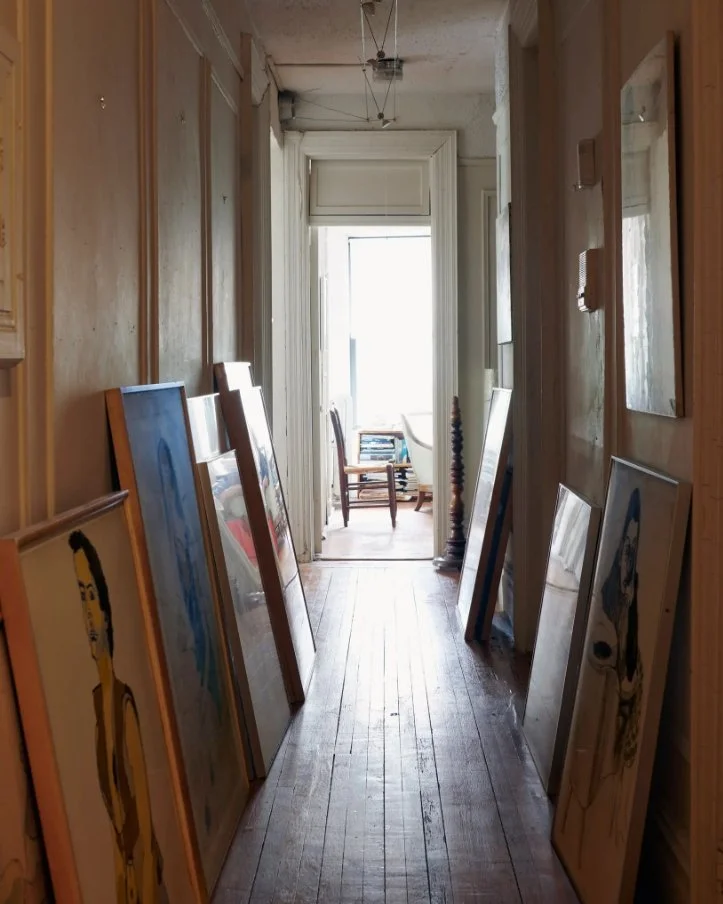
The home and studio of Alice Neel in the Upper West Side in New York where she lived and worked from 1962 until her death in 1984. Photograph by Jason Schmidt. Paintings: © The Estate of Alice Neel
Most artworks have three lives. First in the studio: private, messy, full of edits no one sees. Then in the market: lit, labeled, argued over. If it’s strong, it gets a third life in memory: museum walls, books, classrooms, and the way people carry it in their heads.
Life One: Studio, Where the Language is Built
Last week I spent two hours in Scott Kahn’s DUMBO studio. He pulled out older canvases: several abstract works from the ’60s, a luminous still life, a serene self-portrait. You could track the evolution, from how he trims fuss, how he holds light, why certain edges stay soft. That’s the first life of an artwork: less an “it” picture than a language.
Studios are full of refusals. The floor tells you what didn’t make the wall. Materials are not props; they’re partners or problems. Grounds that won’t sink, pigments that won’t fade, supports that won’t warp; the future conservation of an artwork starts at the first brushstroke. If the decisions are thin here, the next two lives won’t save the work.
Not every studio is grand. Alice Neel painted in her apartment; those constraints shaped the pace and the look. The point is the same: a voice gets earned in private long before it’s performed in public.
Life Two: Market, Where Context Tests the Work
The market isn’t a jury of truth; it’s a stage with rules. A piece can look miraculous in a JPEG and collapse in a booth; another can bloom next to the right neighbor. Placement matters; it’s the paragraph around the sentence.
Think about Philip Guston’s 1970 Marlborough show. He walked in hooded figures, clunky shoes, and cartoon terror while the room still expected late-abstraction decorum. He paid for it at the time. Among several snubs and mocks, Hilton Kramer ridiculed Guston with a review in The New York Times titled “A Mandarin Pretending To Be a Stumblebum.”
Decades later, the same work reads as necessary and blunt. Same canvases, different weather. Context can punish ahead of schedule and reward on the long clock.
The current market compresses time: fairs, links, PDFs, feed speed.
However, the basics haven’t changed: supply discipline, clear pacing, real editing. A flood of near-identical works is inventory, not momentum. When the second life is handled with care, it protects the first and makes the third possible.
Life Three: Memory, Where Evidence Sticks
Memory runs slower. A work crosses into this third life when it starts to teach: when curators build shows around it, when a catalogue pins down its facts, when loans become chapters in the story.
Judy Chicago’s “The Dinner Party” is a good example. Dismissed and moralized over in the late ’70s, it’s now permanently installed at the Brooklyn Museum and used to talk about form, history, and power. That’s what “memory” looks like is persistence and infrastructure.
Provenance becomes structure. So do registrars’ notes, conservation plans, and serious writing. The pieces that last produce consequences wherever they land: on a wall caption, in a seminar, in a mind walking home after closing time.
One Object, Three Rooms
Studio, market, memory: private work, public weather, and then the long view.
These rooms run on different clocks. The studio moves in hours and years; the market in seasons and feeds; memory in decades. Good work becomes bilingual across those speeds. It can survive the fast cut of a fair and the slow patience of a catalogue.
When the system is healthy, each room corrects the others. The studio resists fashion. The market stress-tests ideas in public. Memory sorts signal from noise. Our job as artists, dealers, curators, writers, and viewers is to keep the corridor between them open. Slow the rush when needed, add context where it’s thin, and let disagreement do its work.
The point isn’t consensus but endurance. Let the hype pass through. If a piece can breathe in all three rooms, it will help define a moment.