
The Groove 260 - Why We Need Art and Why Collecting It Feels Like a Superpower
Welcome to the 260th issue of The Groove.
I am Maria Brito, an art advisor, curator, and author based in New York City.
If you haven’t done so, please subscribe here, to get The Groove in your inbox for free every Tuesday.
Why We Need Art and Why Collecting It Feels Like a Superpower
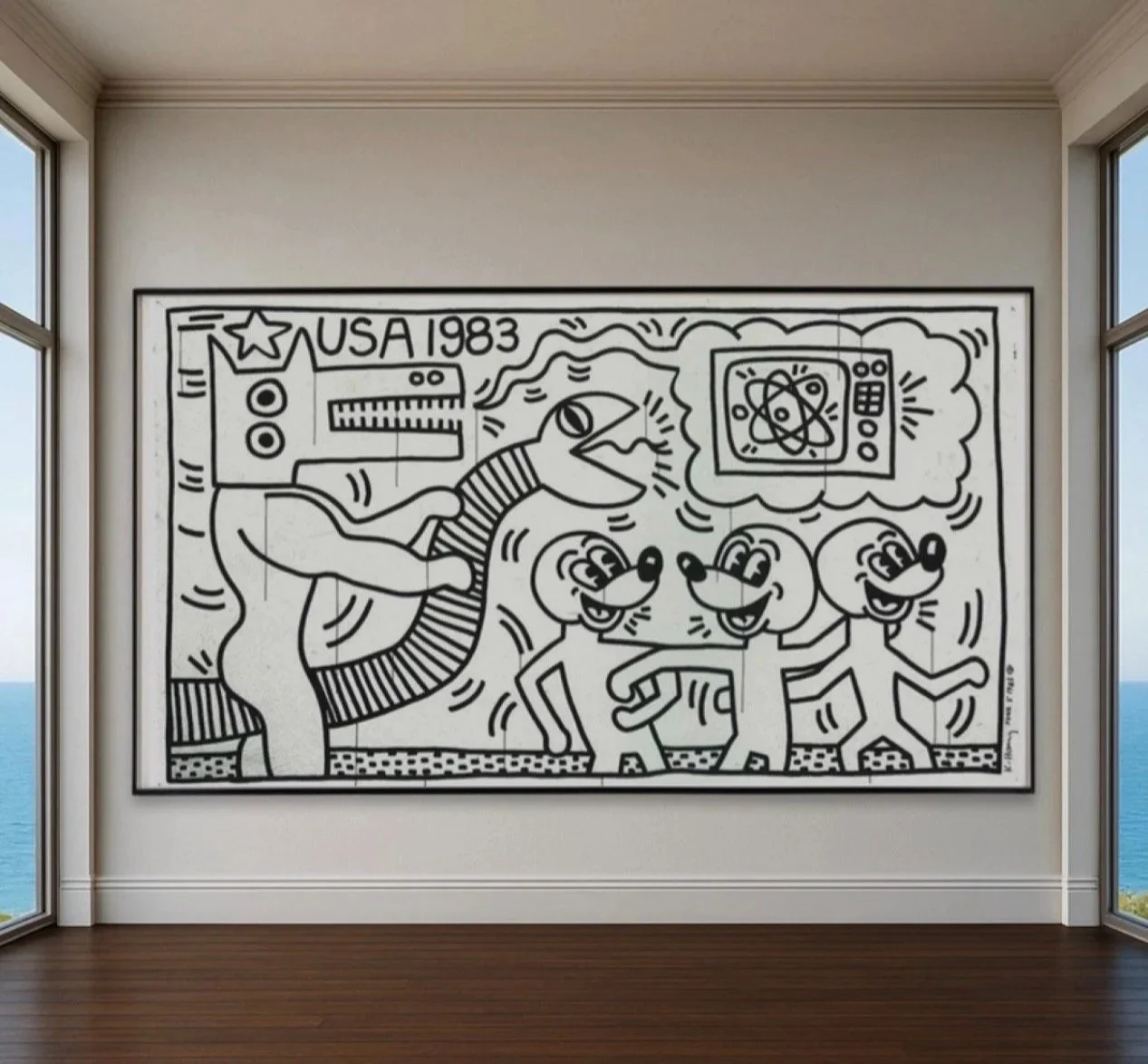
I placed this Keith Haring ink on paper from 1983, which measures 74 x 130 inches, in my client’s collection back in 2011. It holds multiple meanings for its owner and continues to unlock new ones.
There’s a moment that happens in museums and galleries that has nothing to do with art history and everything to do with being human: you stop in front of an artwork, and you feel it. Your body, which is busy, adult and trained, pauses like it just remembered something. You lean in. You look longer. You feel a small rearrangement inside. That’s the point people miss when they talk about collecting as a “luxury.” Art is not a luxury. It’s a portal to discover something inside yourself and in the world that you may not even remember existed.
Attention is a scarce resource now. We live inside a machine that profits from distraction, speed, and low-grade stimulation. Art does the opposite. It slows you down. It asks you to notice. It trains your eye the way a good conversation trains your mind: it makes you more awake.
Collecting, when it’s done with love, turns that awakening into a habit. You don’t “own” a work the way you own a chair. You enter a relationship with it. It lives with you. It changes with you. It gives you back parts of yourself that adult life quietly steals.
Art Is Older Than Writing (And That Should Tell You Something)
Long before we had books and schools and museums, we had images. The cave paintings at Lascaux and Chauvet weren’t decoration; they were world-making. A way to hold fear, hope, ritual, and memory in a form you could return to. The impulse is ancient: drawing and image-making as proof that life was here, and that it meant something.
Then came patronage with pharaohs, popes, princes, and merchants who understood what power looks like when it takes form. The Medici didn’t only finance artists because they liked pretty pictures. They financed ideas and relationships with history that had a deeper meaning. They financed narrative. They financed permanence. Art has always been one of the ways societies decide what deserves to last.
Collecting, too, is not new. Roman elites filled villas with Greek sculptures. Renaissance courts assembled cabinets of curiosities where nature, science, and art sat side by side. That’s the underlying truth: collecting is not a shopping hobby. It’s an old human instinct to curate a world around oneself and say, “this is what I value.”
What Visual Art Does to The Brain
People think they need an art degree to “get it,” but your brain is already doing the work. When you look at an artwork, your visual system is processing color, contrast, pattern, and depth in milliseconds. If the image is compelling, it recruits attention networks that compete directly with distraction. That’s why art can feel like a relief; your mind has something better to do than scroll.
Neuroscience also backs up what collectors intuitively know: novelty and complexity keep us engaged. Art is controlled complexity. It’s a safe encounter with ambiguity, something modern life trains us to avoid. And because art often carries emotion (through faces, gestures, atmosphere, color), it activates the systems we use to read other people. In plain English: you don’t just see art. You simulate it. You feel your way into it.
The most interesting part is what happens over time. Repeated exposure changes perception. Your eye becomes more sensitive to nuance, to the difference between a good painting and a great one, between a clever idea and a deep one. This is literally a form of training. Not “taste” as elitism but taste as perceptual skill. And like any skill, the more you do it, the more it compounds.
Growing Up Is a Creative Injury and Art Is One of the Cures
Children live in a state of creative permission. They make weird choices. They improvise. They don’t need a reason. Then we become adults and we start performing competence: deadlines, status, rationality, productivity. Creativity doesn’t disappear, but it gets managed, delayed, filed away as “not for now.”
Art reactivates that part of you without forcing you to become an artist. You don’t have to paint to be creative; you can live creatively. Looking deeply is a creative act. Living with a work of art that challenges you is a creative act. Choosing what you want to wake up to on your wall is a creative act.
And this is why collecting can be so emotionally charged. People think the intensity comes from money. Sometimes it does. But the deeper intensity comes from identity: your choices reveal you. The work you love is often the work that explains something about you that you couldn’t say with words. Great collecting isn’t accumulation but self-recognition.
Why Collecting Feels So Good and Why It Gets Better as You Age
A good collection is a private ecosystem. It becomes a place your mind can go. The artworks start talking to each other. You begin to notice themes: certain colors you return to, certain subjects you can’t let go of, certain emotional temperatures you crave. Over time, you’re not just collecting objects, you’re showcasing who you are and your own evolution.
Unlike most consumer purchases, art doesn’t get used up. A great painting can hold decades and centuries of looking. It can absorb grief, success, boredom, reinvention. Sometimes you outgrow a piece; sometimes a piece outgrows you. Sometimes a work you barely noticed becomes the one you can’t live without. That’s the pleasure: it keeps changing without moving.
This is also why art collecting has survived every era, from emperors to entrepreneurs. It’s one of the few adult pleasures that engages the eye, the mind, and the heart at once. Not many things do that. A collection is a long conversation with yourself (and with others) and one that you get to enjoy every day of your life.