
The Groove 259 - Proof of Concept: Doha's Cultural Play
Welcome to the 259th issue of The Groove.
I am Maria Brito, an art advisor, curator, and author based in New York City.
If you haven’t done so please subscribe here, to get The Groove in your inbox for free every Tuesday.
PROOF OF CONCEPT: DOHA’S CULTURAL Play
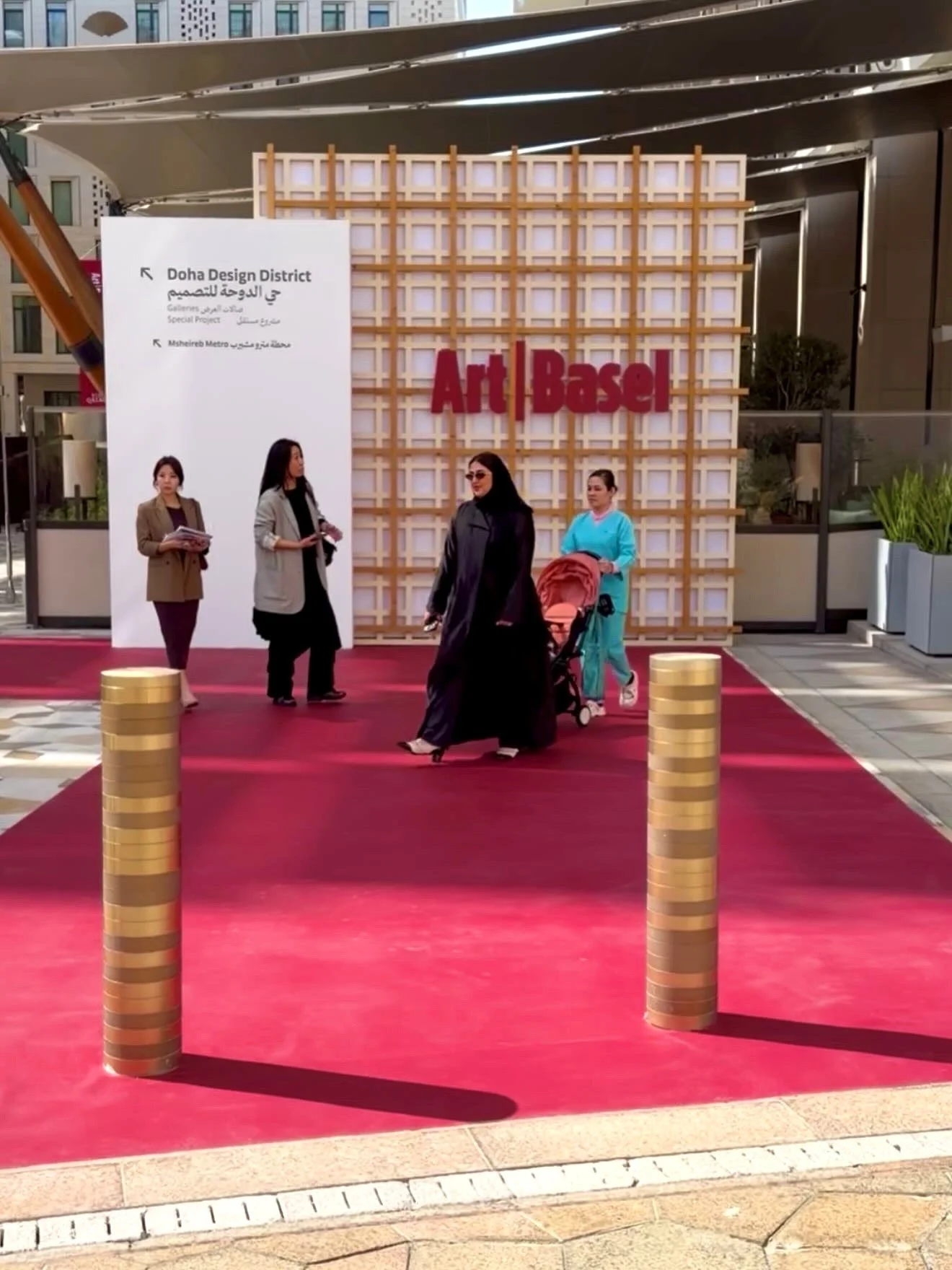
The first edition of Art Basel Qatar took place at the Doha Design District in downtown Msheireb.
Art Basel’s first Qatar edition didn’t try to be Paris or Miami. It set its own tempo: 87 galleries, one-artist booths, museum gravity, no frenzy. It was a fair that asked you to slow down and actually look.
Qatar’s cultural push has a driver: Sheikha Al Mayassa bint Hamad bin Khalifa Al Thani, 42, Western-educated and a collector herself, has turned her vision into institutions and beyond as the chairwoman of Qatar Museums. Her mother, Sheikha Moza bint Nasser, did the same for education, bringing the outposts of universities like Georgetown and Northwestern to Doha to advance both culture and learning.
Ambition With a Plan
Doha isn’t trying to be the Arab version of someone else’s art week. The first edition framed itself as a long game: build audiences, train habits, and let institutions carry the baton. You could feel the curatorial hand even in the commercial halls.
One artist per booth sharpened the encounter. It removed the group-hang safety net and forced depth. This is great for viewers but tougher for dealers. Many used private rooms where they could hang anything they wanted as pressure valves, but the front-of-house message was clear: one voice at a time.
Market behavior matched the tone, because in the Middle East building relationships is a long game: several galleries prioritized museum placement over quick sales. In a market trained to sprint, Doha walked slowly on purpose.
Single-Artist Booths, Real Conversations
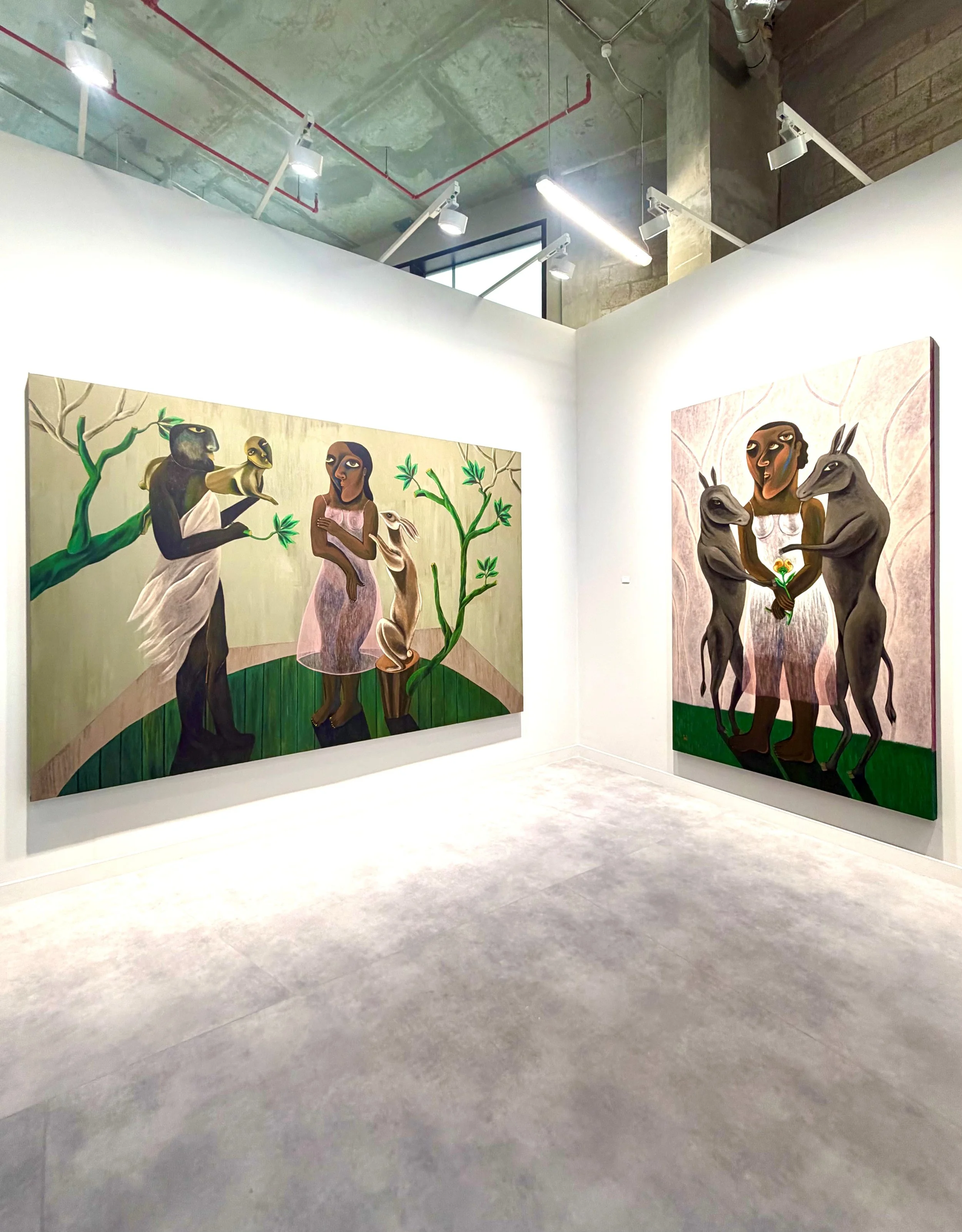
The presentation of Egyptian artist Souad Abdelrassoul at Misr Gallery’s booth at Art Basel Qatar.
The Galleries were tightly curated from all over the world, but the following stood out to me as Middle Eastern proposals championing artists of the region:
Sfeir-Semler’s solo for Syrian painter Marwan (who spent most of his career in Berlin exile) was a masterclass in focus. In the 1970s, he developed what the poet Adonis dubbed “facial landscapes”: heads treated like terrain, Damascus memory fused to portraiture. On the walls, the faces became a fault-lined field of reds and ochres like a geology of feelings, rewarding the slower looking this fair invited. At €600,000 per canvas, this was clearly museum-placement territory.
Nearby, Selma Feriani Gallery offered another regional anchor with Tunisian-American painter Nadia Ayari. Thick, worked surfaces; floral forms that first read as textile and then resolve into deeply layered oil on linen. The paintings operate like survival manuals disguised as still lifes: tactile, deliberate, and grounded in the Mediterranean/American split that shapes her imagery.
And then there was Egyptian artist Souad Abdelrassoul at Misr Gallery, showing her bold, surreal figuration canvases that put women at the center of a living cosmology. Her paintings read like fables for the present: motherhood and desire meeting constraint, with myths and folklore repurposed as psychological armor. The surfaces are assertive and graphic, yet the narratives stay open as allegories that question how women adapt and resist within patriarchal structures.
The City as Classroom
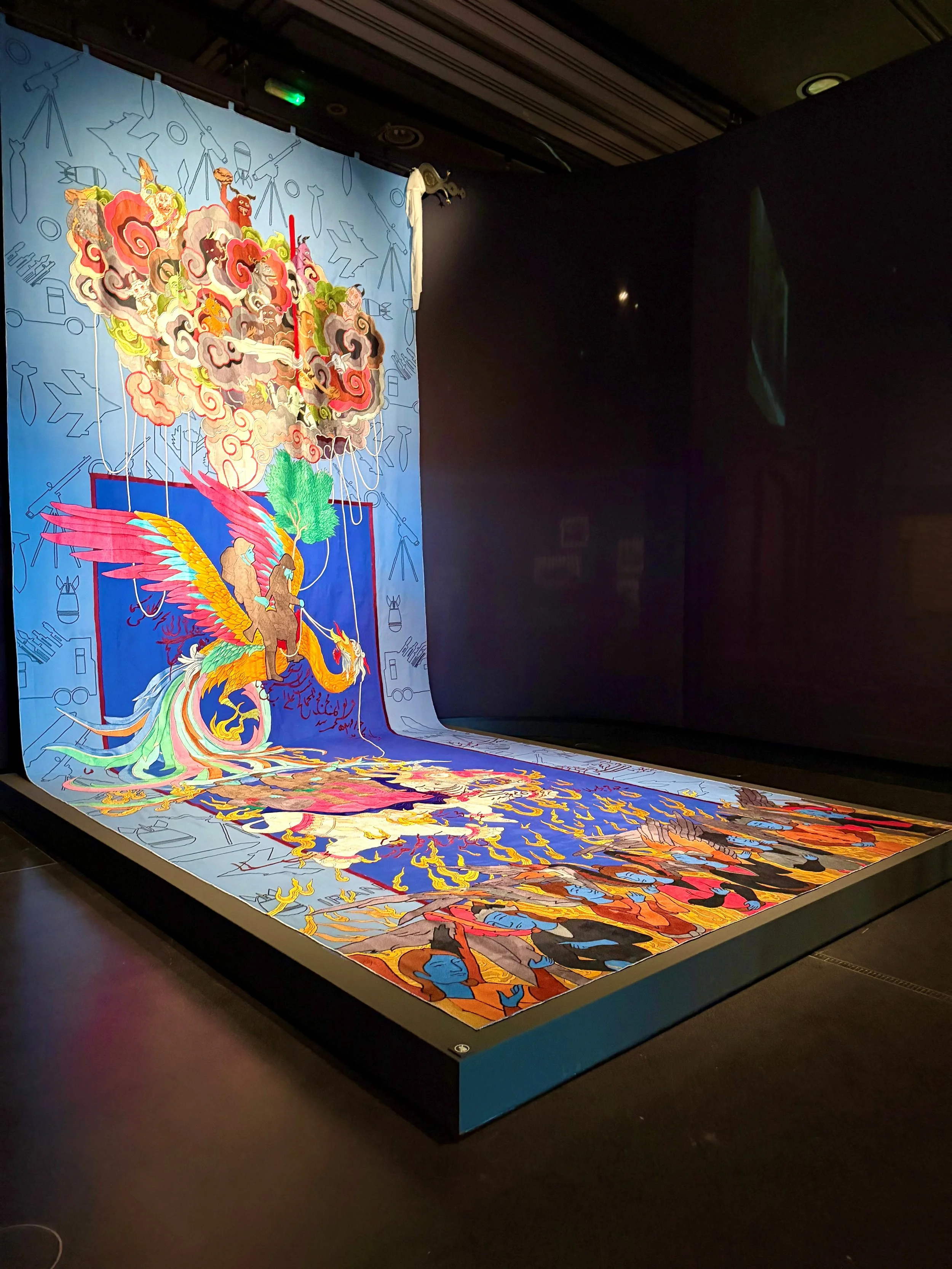
Khadim Ali, Un-Safe Heaven, 2025, synthetic silk, cotton thread on fabric, fabric dye and ink at the Museum of Islamic Art.
At Mathaf: Arab Museum of Modern Art, the exhibit titled “we refuse_d” gathered fifteen artists around ideas of refusal, endurance, and action. The works were made under silencing, censorship, and displacement, yet insisted on presence. Developed through sustained dialogue between artists and curators, it read like a collective statement and a site of solidarity, echoing the spirit (and stakes) of the 19th century Salon des Refusés.
Within that, the through-line of abstraction felt earned. Samia Halaby, the first woman to teach at Yale’s School of Art and a key voice in what she has called “Arabic abstraction” anchored the conversation between form and politics.
Across the water, the Museum of Islamic Art’s “Empire of Light: Visions and Voices of Afghanistan” reframed a country too often flattened by headlines. Ancient cities, sacred sites, and rare objects sat in dialogue with contemporary textile installations by Hangama Amiri and Khadim Ali. These impressive large-scale, hand-worked pieces turned fabric into archive and testimony. The takeaway wasn’t “East vs. West” but instead cultures meeting, ideas thickening, creativity taking new forms.
What Art Basel Qatar Signals
Many galleries optimized for institutional placements, which was the correct move. In this part of the world, first editions aren’t for fireworks; they’re for laying foundations. With no satellites tugging at attention, the fair kept its center of gravity where it belonged.
The audience set the tone: educated and unhurried, with no hard sells, even in the souks. “No” was accepted, curiosity rewarded.
If Doha keeps this pace of single-artist focus for the next couple of years, with real museum partnerships and commissions with regional voice, it will build durability.
You could feel an ecosystem knitting itself together: institutions, galleries, an audience learning to move in time. That’s how a fair becomes a habit, and a habit becomes a culture.