
The Groove 267 - Venice on Fire
Welcome to the 267th issue of The Groove.
I am Maria Brito, an art advisor, curator, and author based in New York City.
If you haven’t done so, please subscribe here, to get The Groove in your inbox for free every Tuesday.
VENICE ON FIRE
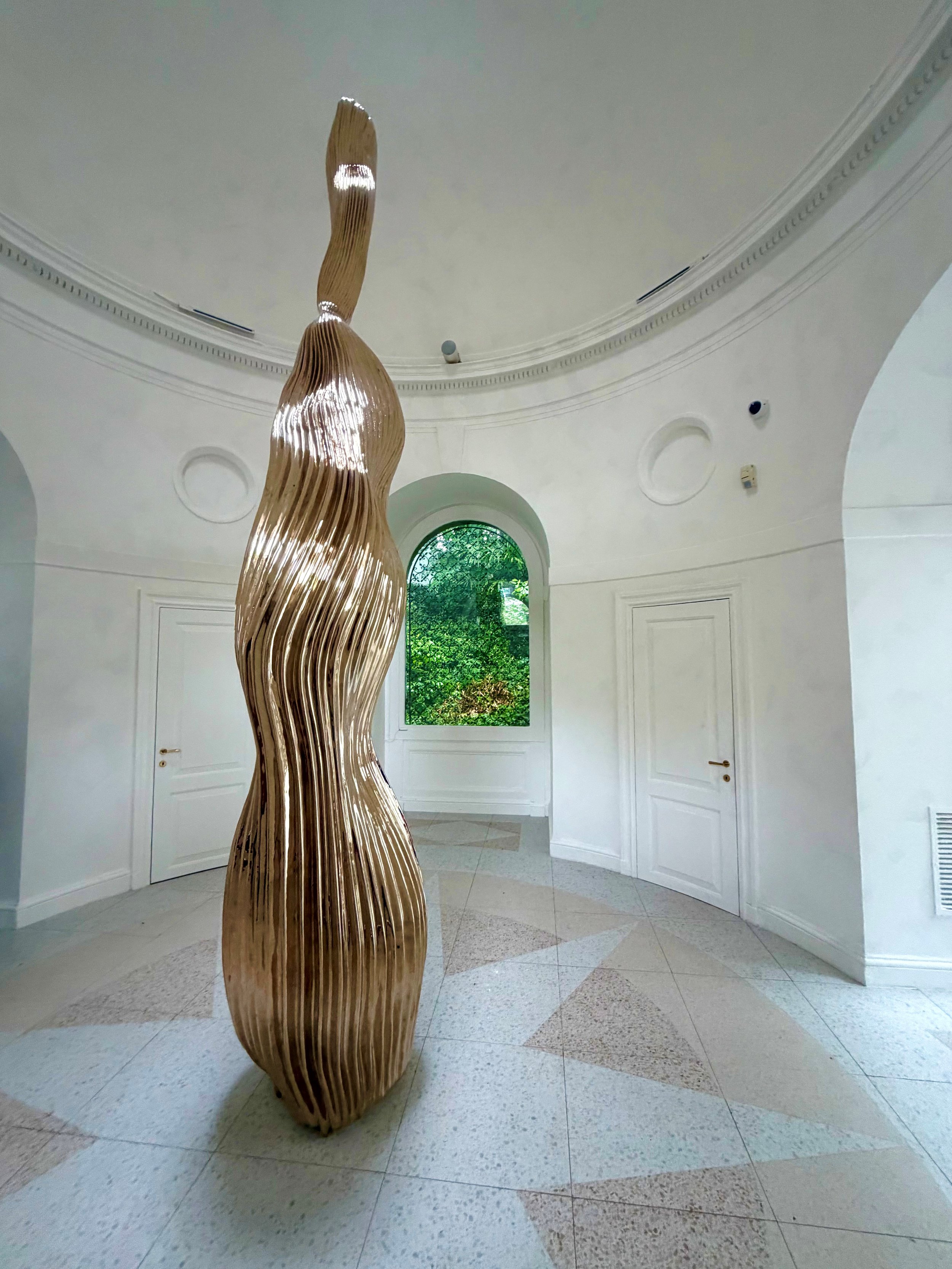
One of Alma Allen’s bronze sculptures inside the US pavilion at the Venice Biennale last week. Photo: Maria Brito.
The 61st Venice Biennale feels like the most controversial, convoluted edition in recent memory. And that’s saying something for an event that has been political since its inception in 1895. Venice is an art exhibition, yes. But it is also a national stage: more than 70 countries designate artists to represent them in pavilions across the Giardini, the Arsenale, and throughout the city. Venice doesn’t merely showcase culture; it stages soft power.
This year the drama had an extra accelerant. The curator of the main exhibition, Koyo Kouoh, who was Cameroonian-Swiss, brilliant, and widely respected, died in 2025 after a cancer diagnosis, leaving her team to complete her vision without her.
Even when institutions insist on continuity, a posthumous edition carries a different charge. It’s the same guidebook, but the author is gone. The absence becomes part of the atmosphere and the atmosphere was tense.
That question is the tension at the heart of this moment: we love art as a human achievement, but we keep talking about it like stock.
When National Representation Collides with Real-World Geopolitics
This is the year the pavilion structure turned into a live wire. Enter Russia, Israel, and Iran. (South Africa and Australia also had major issues). Iran withdrew. Israel pressed ahead. Russia’s participation triggered the loudest institutional reaction: the EU threatened to pull its €2 million funding over Russia’s inclusion and eventually it did.
Russia, for its part, leaned on an inconvenient technical reality: it owns its pavilion. What followed was a kind of compromise that satisfied no one: heavy restrictions, symbolic gestures, and the inevitable result of sanctions-era culture - a pavilion that became more about access and legitimacy than about whatever was installed inside.
The most consequential fallout wasn’t a protest outside a gate. It was the collapse of the Biennale’s own credentialing machine. The international jury, a group handpicked by Kuoh tasked with awarding the Golden Lion for Best National Participation, the Golden Lion for Best Participant in the International Exhibition, and the Silver Lion for a promising participant, resigned en masse two weeks ago.
That is a big deal. Because the Golden Lion is Venice’s way of distributing influence. The kind of influence that reroutes museum attention, accelerates acquisitions, and stamps narratives into art history books. When the jurors walk out, it isn’t just an administrative problem. It’s the Biennale admitting, in public, that the political conditions of the moment can overwhelm the institution’s ability to “judge” as usual.
AMERICA’S PAVILLION, AMERICA’S PROXY WAR
As if the macro-politics weren’t enough, the United States pavilion arrived with its own saga, one that has been framed in the press as part bureaucratic mess, part culture war.
The typical process that entails an open call and long runway managed by the State Department didn’t unfold cleanly this time. A project involving Robert Lazzarini and curator John Ravenal was selected and then collapsed before it could properly launch, reportedly due to funding/liability issues and internal breakdowns. (Lazzarini is a friend of mine but I didn’t reach out. I didn’t want to add oxygen to an already over-oxygenated fire.)
Then, at the end of 2025, the U.S. announced Alma Allen, Utah-born and Mexico-based, with Jeffrey Uslip as curator. More backlash followed: about caliber, about “fit,” about what kind of art is allowed to represent the United States in 2026.
There were reports that Allen’s galleries dropped him after the appointment. Later, Perrotin announced Allen’s representation and an inaugural show in Paris in October 2026, timed to Art Basel Paris. In other words: the pavilion became a battleground before most people saw the work.
I was there last week. I saw a ton of art: old, new, brilliant, mediocre, moving, ridiculous. I also saw Alma Allen in person: painfully shy, speaking to the press as if he had to justify his existence. That bothered me, because whatever you think of his work, he is not a political talking point. He is an artist. He has been making sculptures for more than three decades. The temperature around him felt preset, as if the verdict had been written before the object was even allowed to speak.
THE BRITTLE DISCOURSE
Allen’s pavilion is not a manifesto. It’s not an attempt to perform national identity or to package an ideology. It is sculptures in bronze, marble, and wood presented without the familiar contemporary requirement that everything arrives with an explicit moral caption. You can dislike that. You can find it insufficient. You can call it conservative, inert, not for you. Fine. That’s critique.
But what’s been happening around it often doesn’t read like critique. It reads like a proxy war: the artist as a surrogate for a broader rage at process, politics, and the American moment. I doubt Trump knows what the Venice Biennale is, but the atmosphere has been so intense that I wouldn’t be shocked if it gets sucked into a broader narrative machine anyway. That’s how brittle the discourse has become.
That brittleness is the part I can’t ignore. The American art world often behaves as if there is one acceptable moral tone at any given time, and deviation is treated not as disagreement but as defect. Many collectors and gallerists privately say they feel this pressure. Publicly, they don’t want to be ostracized, so they stay quiet. I get it. I also think it’s dangerous.
And that’s why, when I ran into Kelly Crow, the wonderful journalist who covers the art market for The Wall Street Journal, I told her bluntly: “Everyone is on edge. The art world says it’s inclusive, but everyone is fighting everything right now.” She quoted me in her piece published last week. I stand by it. Because if this is the space we claim for creativity and for open-mindedness, for contradiction, for the joy of making things that outlast us, then we should be able to hold complexity without turning every disagreement into a purge.
People love to say art transcends the moment. It can. But only if the ecosystem allows it to.