
The Groove 278 - The Right Painting at the Right Time
Welcome to the 278th issue of The Groove.
I am Maria Brito, an art advisor, curator, and author based in New York City.
If you haven’t done so, please subscribe here, to get The Groove in your inbox for free every Tuesday.
The Right Painting at the Right Time
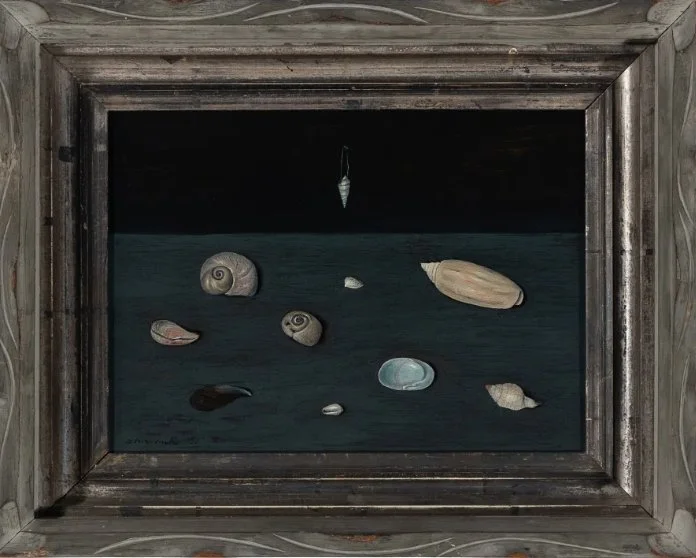
Gertrude Abercrombie, Alderman Merriam's Shells, 1951. Oil on masonite in original frame. 8 x 11 inches.
There is a particular fantasy that keeps every flea-market shopper digging through other people’s junk: somewhere between the chipped china and the dead man’s record collection is a masterpiece nobody else noticed.
This past July, a man arrived late to an estate sale in Michigan looking for vinyl and mid-century furniture. In a dark hallway leading to the garage, he spotted a tiny painting of seashells signed “Abercrombie ’51.” He paid $30 for it.
Last week, that same 8-by-11-inch painting sold at Freeman’s for $1,352,600, setting a new auction record for Gertrude Abercrombie. Five telephone bidders chased it past an estimate of $150,000–$250,000. It’s a fabulous jackpot story, but the $30 is actually the least interesting part. The painting didn’t change between the time it was made and the auction room where it sold, but everything around it did.
the world’s most profitable Vacation Detour
The buyer wasn’t an art dealer or an Abercrombie expert. He was a longtime hunter of records and mid-century furniture who noticed a signature and took a chance. After doing some research, he changed his family’s vacation plans to visit “Gertrude Abercrombie: The Whole World Is a Mystery” at the Milwaukee Art Museum. This may qualify as the greatest return ever generated by making your family go to a museum on vacation.
While looking through the museum’s exhibition catalogue, he found a photograph from a 1952 Chicago Tribune review. And there was his painting, in its original frame, beside the actual shells Abercrombie had painted. Scholar Susan Weininger later authenticated it and its history emerged. Abercrombie painted Alderman Merriam’s Shells in 1951 and gave it to a doctor in exchange for medical services. It remained in his family for more than seven decades.
Think about this. First there was an 8-by-11-inch object and a signature. Then came an archival photograph, provenance, exhibition history, scholarship and authentication. Nothing really happened to the painting, but knowledge had been built around it.
It Takes a Village to Make a Record
Authentication explains why the painting wasn’t worth $30; however, it doesn’t explain why five bidders were willing to chase it to $1.35 million. For that, we have to go back to 2018, when Karma, the excellent gallery with outposts in New York and LA, mounted Abercrombie’s first New York solo exhibition since 1952. Before then, her paintings generally traded around $10,000 at auction, and her entire auction market in the preceding year totaled less than $75,000.
Karma did what serious galleries do when they believe history has overlooked someone: they showed the work, published scholarship and put it in front of collectors, critics and curators. Museums followed. A major retrospective opened at the Carnegie Museum of Art in 2025, which then traveled to Colby, Milwaukee and is now opening on October 16th at the Norton Museum of Art in Palm Beach. By the time this painting emerged from a Michigan hallway, the art world had spent eight years learning to care about Gertrude Abercrombie.
Timing is as important as authentication. Had the same man found the same painting in 2018, with the same archival evidence and provenance, we can’t know what it would have sold for. But we know it wouldn’t have entered today’s Abercrombie market because that market hadn’t been built yet. Same painting. Different world.
History Needs Receipts
People often talk about art prices as though value lives somewhere inside the canvas: How can that little painting possibly be worth $1.3 million? But value in art is constructed by an entire ecosystem around the object.
Look at how many people it took to turn $30 into $1.35 million. Abercrombie made it. A doctor preserved it. A newspaper photographed it. An archive kept the evidence. Scholars reconstructed its history. Karma spent years rebuilding attention and a market around the artist. Museums gave her work institutional context. Freeman’s brought the painting to public auction. And finally, several people with money wanted the same thing at the same time.
Scholarship equaled certainty and context created importance. Scarcity has engineered desire and competition generated the price.
Somewhere between a dark hallway in Michigan and an auction room in New York, a $30 painting became a $1.35 million painting without changing at all. But we did. We learned who made it, where it had been and why it mattered. Perhaps that’s the strangest thing about value in art: sometimes the object is the only part of the equation that stays exactly the same