
The Groove 263 - The Oscars of the Art World (Except... Not Really)
Welcome to the 263rd issue of The Groove.
I am Maria Brito, an art advisor, curator, and author based in New York City.
If you haven’t done so, please subscribe here, to get The Groove in your inbox for free every Tuesday.
THE OSCARS OF THE ART WORLD (EXCEPT… NOT REALLY)
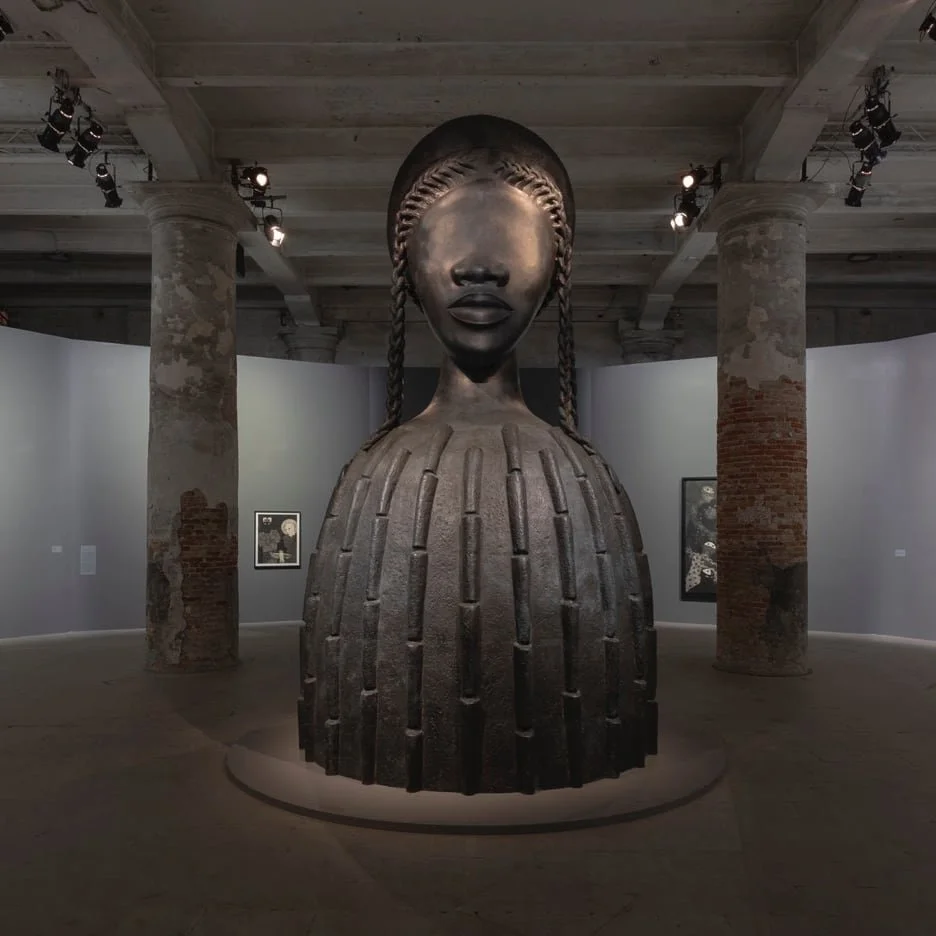
Simone Leigh, Brick House, 2019 was shown at the 59th Venice Biennale in 2022 and won the Golden Lion for the best participation in the central exhibition.
Less than 48 hours ago, the Academy of Motion Pictures Art and Sciences, AKA the Oscars, handed out gold statues in a room most people will never enter. In about six weeks, the Venice Biennale will hand out Golden Lions and then open its doors to anyone with a ticket and comfortable shoes. That difference matters. The Oscars are mass culture judged by insiders. The Biennale is insider culture that becomes public after the preview. Both are part of awards seasons. Both are status machines. But they run on radically different kinds of access.
Movies are the most democratic art form we have: more people watch films in a week than will visit museums in a year. The Venice Biennale, by contrast, is physically and psychologically niche: an art pilgrimage that requires time, travel, stamina, and a tolerance for ambiguity. Yet Venice is also, in a strange way, more open: after the VIP days, you can literally buy a cheap ticket to walk in and see what the world’s cultural gatekeepers are arguing about.
So yes, the Oscars are mainstream and Venice is rarified, but they’re cousins. Both create a narrative of “the best.” And both reveal how culture is actually made: by juries, institutions, commissioners, and systems that decide which stories get elevated.
The Same Machine, Different Audience
At the Oscars, the audience is global and the room is closed. At Venice, the room is open and the audience is comparatively small. That’s the trade: film has mass distribution but elite access; Venice has limited distribution but public entry. One is the world’s biggest cultural mirror; the other is a curated lens.
And both have a two-tier reality. Hollywood has the ceremony (public if you have streaming or cable TV), the parties (private), and the campaigning (semi-private). Venice has the pavilions and Giardini/Arsenale (public after preview), and then the private dinners, the yacht conversations, the sales and pitches to collectors and curators that most people never see but shape which artists gain momentum.
The most honest way to say it is this: the Biennale isn’t democratic in price levels, power levels, invitations to participate as an artist or who gets to go to the preview days. But it is democratic in one essential way: after the gates open, anyone can see what the cultural class is rewarding. That access to the argument is not nothing.
The Golden Lion: Venice’s Oscar, With a Twist
The Golden Lion functions like the Oscars, but with a twist: Venice splits its trophies across different structures of cultural power. There’s the award for Best National Participation (the pavilion as a country’s cultural statement) and awards inside the International Exhibition (the curator’s thesis show), plus the Silver Lion and special mentions. The system is basically telling you the ideas they want to solidify and legitimize.
But unlike the Oscars, which rewards a finished product, Venice often rewards a method: research, endurance, formal clarity, and cultural stakes. It also rewards a kind of institutional literacy: how well an artist can use the pavilion format, how tightly an installation carries its argument, how a work functions as both aesthetic experience and historical claim. This is why the Lion can feel less like a “popularity” prize and more like a stamp of permission for a certain kind of seriousness to take the microphone.
And sometimes that permission changes history. Robert Rauschenberg’s 1964 grand prize win is still the Biennale’s most famous “Oscar night”; a career-shifting moment that sparked accusations of U.S. power play and backroom maneuvering.
More recently, the Lion often works as confirmation and acceleration: Marina Abramović’s Balkan Baroque (1997) helped fix performance as major art, not a side category. Adrian Piper’s 2015 Golden Lion elevated a conceptual practice that insists on ethics and accountability. And in 2022, Venice crowned Simone Leigh (Best Participant in the International Exhibition) while the UK pavilion by Sonia Boyce won Best National Participation. It’s proof that the Lion still matters, even if it now tends to validate and amplify what institutions are already building rather than what they “discover” from scratch.
What both the Oscars and the Venice Biennale prove is that culture isn’t only made by artists but by systems: juries, lobbyists, institutions, commissioners, money, and timing. The Oscars hide most of that behind glamour. Venice puts it on the street after opening week. That’s why I love the Biennale even when it frustrates me: it’s one of the few places where you can watch taste being written in real time, and then go back the next day to argue with it.