
The Groove 264 - The Hand Wins - Living with Art in the Age of AI
Welcome to the 264th issue of The Groove.
I am Maria Brito, an art advisor, curator, and author based in New York City.
If you haven’t done so, please subscribe here, to get The Groove in your inbox for free every Tuesday.
THE HAND WINS: LIVING WITH ART IN THE AGE OF AI
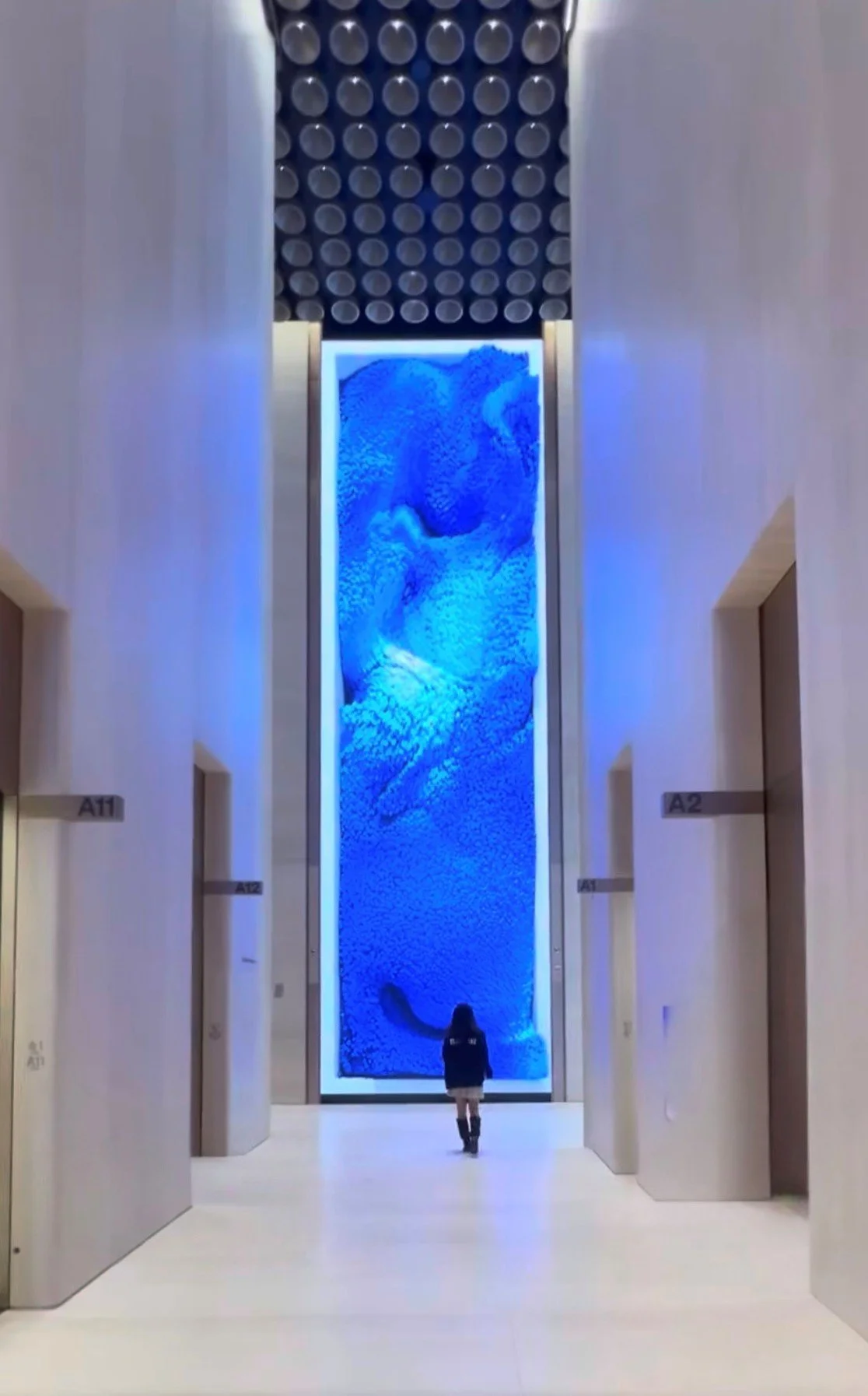
Refik Anadol’s AI Data sculpture at the headquarters of JPMorgan Chase in New York. Photo (c) Maria Brito.
AI can produce a picture in five seconds. Ten thousand variations in a minute. It can mimic a style, remix a face, invent a scene, and make it look “finished” enough to pass on a phone screen. And yet I’m not seeing serious collectors suddenly pivot into “AI art.” If anything, I see the opposite: a stronger hunger for objects that announce, unmistakably, that a human being stood here and made this.
The hand is an instrument of care. It’s the place where talent becomes visible effort; where time, patience, and obsession leave a trace you can feel. In a culture drowning in frictionless images, the hand reads like the truth.
So the real question isn’t, “will AI replace artists?” That’s lazy thinking. The real question is: what happens to value, to collecting, to devotion, when images become infinite and the handmade becomes scarce?
The Hand Is Not a Style. It’s a Signature of Life.
We used to talk about the hand as connoisseurship, brushwork, touch. “You can spot it across the room.” But the hand isn’t only a fingerprint. It’s a nervous system that carries temperament. Urgency. Restraint. Desire. That’s why you can stand in front of a Rembrandt and feel the pressure of life, not just the mastery of paint. Why a Goya can feel like a heavy confession or a Morisot like breath and longing.
Even modernity, which loved to pretend it was done with craft, still reveals itself through touch. Van Gogh’s surface is basically a pulse. Giacometti’s figures are anxiety made physical. And when someone like Agnes Martin gets “minimal,” the point isn’t just simplicity, but deep discipline: hand-drawn lines that insist on attention, humility, and repetition. AI can imitate the look, but it can’t imitate the lived reason the hand kept returning to the same line.
This is why the handmade has become a luxury signal again. Not because people want quaintness, but because they want proof of commitment. A ceramicist fires and risks losing everything. A sculptor chooses weight and balance and failure. A draughtsperson can’t hide behind production. The hand is where life itself becomes visible.
What AI Changes (And What It Can’t Touch)
AI changes image production. It doesn’t change the human desire to live with objects that feel real. A collector doesn’t only buy an image; they buy authorship, a story, someone being answerable for the work. The chain of responsibility matters. Who made this? Why does it exist? What does it belong to? Where does it sit in a lineage?
And lineage isn’t just a romantic word. It’s how culture becomes legible. When you see a Matisse drawing, you’re not only seeing a line, you’re seeing a lifetime of looking. When you see a Lucian Freud, you’re seeing time compressed into flesh. When you see a Louise Bourgeois spider, you’re seeing childhood, fear, protection and emotion become form. These works are a transformation. That’s what the hand does: it turns private pressure into public structure.
AI also breaks something the art market depends on: shared standards of proof. If an image can be generated endlessly, what exactly are you buying? A file? A prompt? A license? A token pointing to something infinitely reproducible? The art world can handle editions because there’s still a stable concept of authorship and control. With AI, that stability is shakier and serious collectors feel it immediately, even if they don’t articulate it.
The Future
I think the next phase won’t be a mass “AI art collecting” wave. AI will become like Photoshop: a tool some artists use brilliantly and others use lazily. Museums will show it, critics will argue about it, and collectors will selectively engage when the work carries real stakes.
What will rise is the premium on evidence. Process becomes part of value: studio documentation, material notes, provenance, conservation plans, fabrication records, installation instructions. In an era of synthetic everything, the market will reward what feels honestly made.
And the deeper shift will be emotional. AI makes everyone wonder, even subconsciously: Is anything real? Living with art and collecting it becomes a way of answering that with your environment. People will choose objects that anchor them. Artworks with gravity, imperfection, idiosyncrasy, and human presence. The hand will feel less like a technique and more like truth.
AI will flood the world with images. Fine. Let it. Collecting has never been about owning more images; it’s about choosing what deserves to stay. The more the culture becomes frictionless, the more we’ll value friction: the trace of a decision, the evidence of time, the proof of caring. The hand is not just how art is made. It’s how love becomes visible.