
The Groove 265 - The Exit, Curated
Welcome to the 265th issue of The Groove.
I am Maria Brito, an art advisor, curator, and author based in New York City.
If you haven’t done so, please subscribe here, to get The Groove in your inbox for free every Tuesday.
THE EXIT, CURATED
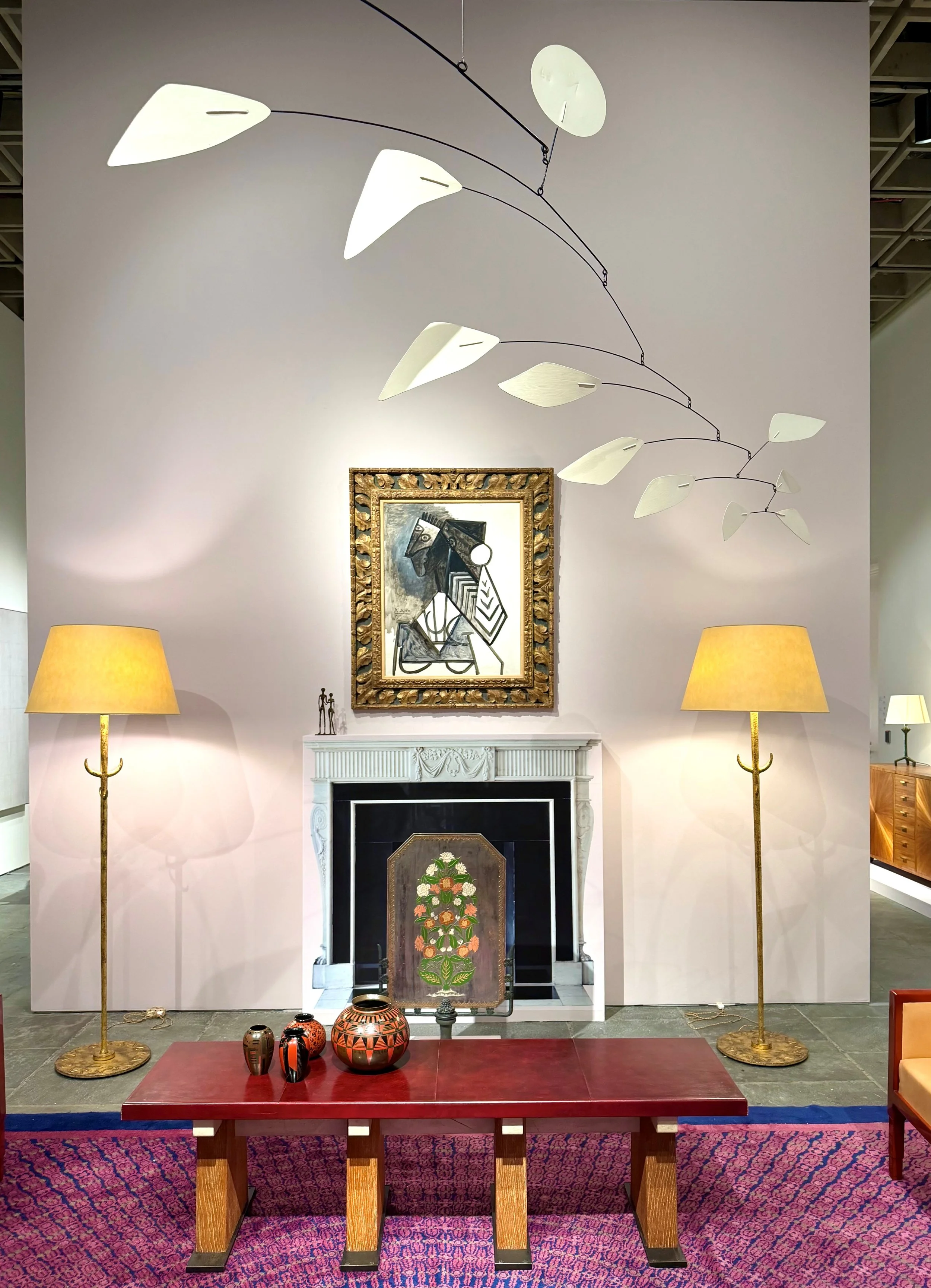
ROne of the many areas on the fourth floor of Sotheby’s replicating the living spaces of the de Gunzburgs, whose design sale is also anchored by wonderful works of art, like the 1955 Picasso Buste de Femme, or the 1963 white Calder mobile.
Buying gets all the romance. The chase, the story. The first time a painting lands on your wall, and suddenly your living room feels like it acquired its own nervous system. Selling is the part the art world talks about in hushed tones, as if letting go is a sin.
But the truth is that collecting has a fourth act nobody teaches: the edit. The release. The moment you decide whether you’re a keeper of objects, or the author of a life with objects.
This weekend I stopped by Sotheby’s to browse the upcoming de Gunzburg sale. The entire fourth floor of The Breuer building has been divided into replicas of the many living areas inside Jean and Terry de Gunzberg’s homes. The couple decided to sell almost all the art and design treasures they had accumulated and lived with for decades. This is a public look at the collector’s hardest skill: knowing when the work you bought for your dream life needs to move on to someone else’s real life.
And then there’s the detail that makes the whole thing almost too perfect as a metaphor: the most coveted design lot in the April sale is a suite of 15 Claude Lalanne mirrors commissioned for Yves Saint Laurent and Pierre Bergé’s music room, acquired by the de Gunzburg’s in 2009 as a single lot and never installed. Not once.
That is a quintessentially human story. Sometimes you buy the room in your head. The room never arrives. The object waits.
The Boomer Edit: When Collections Become Logistics
There’s a quiet shift happening across the upper tier of collecting: prominent Boomer-era collectors are editing, not just accumulating. Call it divestment if you want, but that word makes it sound like a retreat. It’s often the opposite. It’s a mature recognition that a collection is not only emotional; it’s administrative. It’s storage. Insurance. Conservation. Shipping. Loans. Paperwork. The invisible labor that follows every “yes.”
This is also why the phrase, “I’m leaving it all to my kids” is less romantic than it sounds. People don’t inherit taste. They inherit decisions and the work required to maintain those decisions. Even the most loving heirs can end up burdened by objects they didn’t choose, can’t place, and don’t know how to steward. The edit becomes a form of care.
And the YSL/de Gunzburg mirrors crystallize the point. They weren’t bought casually. They were bought as a complete environment: a room’s worth of desire, history, and design mythology. But a suite like that doesn’t behave like a single painting. It demands architecture. It demands a perfect scenario. When the scenario doesn’t exist, the objects become something else: pristine, legendary, and waiting for a new narrative.
Off-Season Is the New Strategy
Here’s another trend that’s hiding in plain sight: auction houses are using the social recognition of collectors to schedule sales outside the traditional calendar, relieving the gridlock of New York’s congested May and November seasons. In other words, they’re selling bandwidth as much as they’re selling objects.
An off-season sale only works if the sellers have stature and the material feels aligned with the moment. But when it works, it’s brilliant. It creates a single story that’s easier to understand than a crowded evening sale packed with competing estates and competing agendas. “Here is a world,” the sale says. “Enter it.” That narrative is a powerful drug.
And it’s not just a calendar hack, it’s an attention strategy. The market is crowded and everyone is fighting for oxygen. A tight, single-owner sale with 123 lots, one voice, and a clear look cuts through the noise. It’s the difference between a playlist and an album. One is content. The other is a point of view.
Design’s Fine-Art Moment
Design is no longer the charming cousin in the family: it’s walking into the room and taking the best seat. Lalanne is the obvious emblem of this shift: objects that function as sculpture command instant recognition and now pull numbers that used to belong almost exclusively to “fine art.” Once a design object can clear eight figures, the debate about whether it’s “decorative” becomes irrelevant. The market has voted.
But the deeper reason design is surging isn’t only scarcity or glamour. Design sits at the intersection of function and fantasy. You don’t just own it; you’re supposed to live with it. In an era where so many people curate their lives like sets, design becomes a particularly potent form of cultural self-portraiture. It’s not just what you collect, it’s the world you stage.
And that’s why this sale is so instructive: it isn’t design versus fine art. It’s design with fine art, the same way sophisticated homes actually work. This is about a sustained engagement, an eye that could give pride of place to less obvious choices, like Mark Grotjahn, alongside bigger names like Mark Rothko, all while building a design universe with real gravity. That mix is increasingly what good collectors want: not categories, but coherence with a strong point of view.
The Hardest Skill: Knowing When It’s Time To Let Go
The most prized lot in the April sale being “never installed” is the kind of detail that reads like a parable. It’s not about regret, it’s about mismatch. Sometimes a work is extraordinary and still wrong for the life you actually live. Sometimes you love something, buy it, and then discover that it doesn’t fit: not in the room, not in the rhythm of your days, not in the architecture of your attention.
And here’s the grown-up truth: owning something isn’t the same as living with it. Collectors love to talk about the chase, the score, the win. But the real sophistication is knowing when to release an object back into circulation so it can become fully itself somewhere else.
Buying is the glamorous part of collecting. Editing is the brave part. In 2026, that may be the most modern kind of collecting story there is: not the acquisition, but the exit that is curated with the same intelligence as the entry.