
The Groove 281 - The Art Market is a Bad Laundromat
Welcome to the 281st issue of The Groove.
I am Maria Brito, an art advisor, curator, and author based in New York City.
If you haven’t done so, please subscribe here, to get The Groove in your inbox for free every Tuesday.
The Art Market is a Bad Laundromat
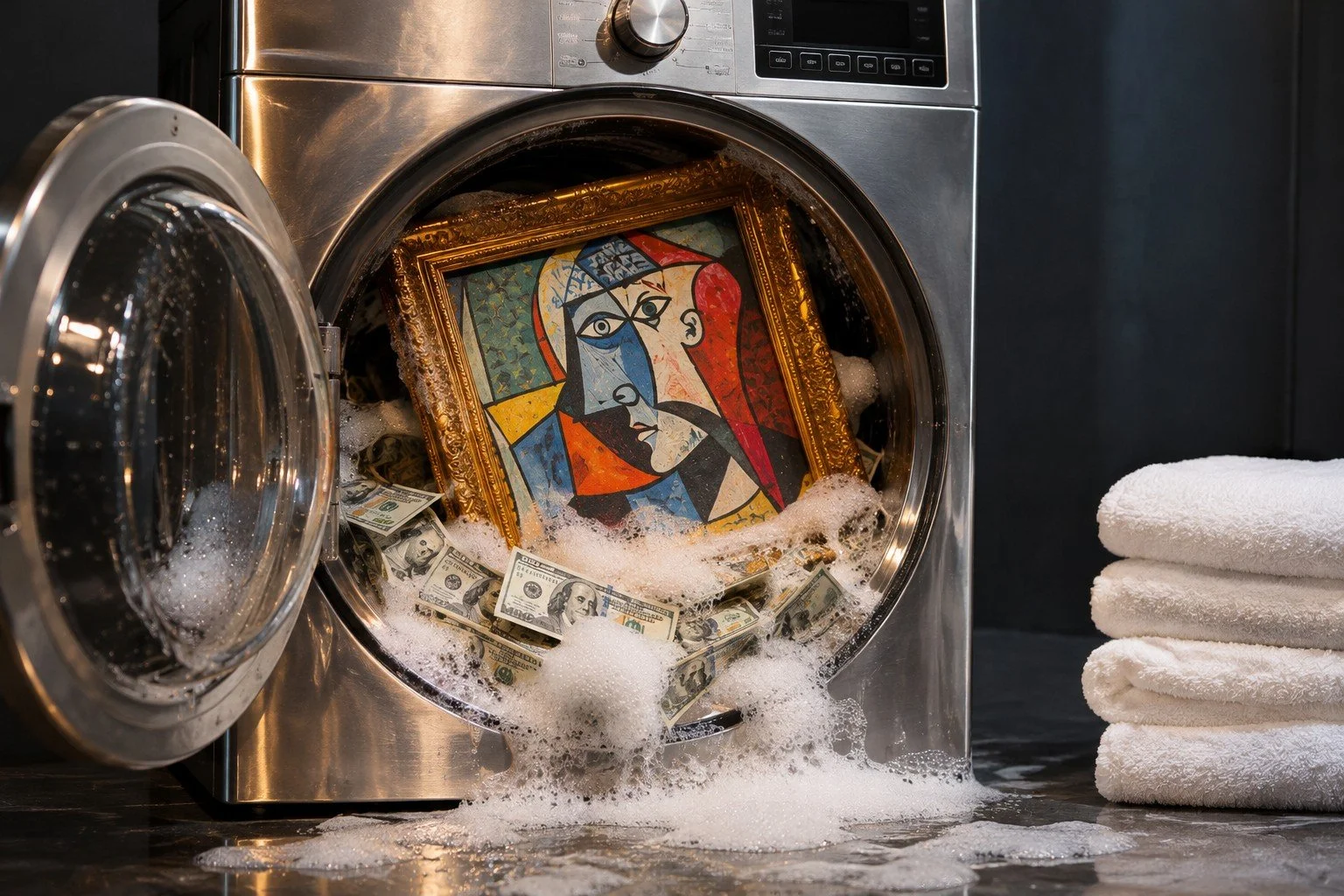
According to financial-crime research firm Napier AI, an estimated $5.09 trillion was laundered worldwide in 2025, that’s roughly 85 times the $59.6 billion in global art sales reported by Art Basel and UBS.
The quickest way to discover an army of amateur forensic accountants is to post a $50 million painting on Instagram. Within minutes, the comments arrive: “Money laundering!” “Nobody pays that much for art!” Apparently, encountering a price beyond your own bank balance is now sufficient evidence of a felony.
Nevermind that billionaires collect art for pleasure, prestige, investment, competition, or simply because they can. The internet has already solved the crime.
Which makes a recent Financial Times article particularly delicious. Following a string of European museum heists, including the audacious theft of eight pieces of royal jewelry from the Louvre in October 2025, the paper reported that European Commission experts plan to downgrade the art market’s money-laundering threat from high to moderate.
Their reasoning? The limited evidence linking these thefts to laundering or terrorist financing. The assessment isn’t final, and regulators acknowledge vulnerabilities. But the timing raises a question: has the art market’s criminal reputation become considerably larger than the criminal activity itself?
Stealing Isn’t the Same as Washing
Let’s get something straight. People steal art. Criminals buy art. And yes, artworks have been used to conceal illicit wealth. The notorious 1MDB scandal in Malaysia involved millions spent on paintings by artists including Picasso, Monet and Van Gogh. But stealing a masterpiece and laundering money through the legitimate art market are very different operations. One requires getting your hands on the object, while the other disguises the origins of the money.
Consider the Louvre heist. The thieves targeted jewelry, which can potentially be dismantled, melted down or recut. Try doing that with a Picasso. A famous painting is recognizable, documented, difficult to sell discreetly and often impossible to move through reputable channels without questions. It may have enormous theoretical value but is practically unsellable to a legitimate buyer.
Julian Radcliffe, chairman of the Art Loss Register, made precisely this point to the Financial Times: criminal networks simply cannot move enough stolen art to make a meaningful difference to large-scale laundering operations. Stealing the painting is the easy part. Finding someone willing to buy it without attracting the police? Considerably less entertaining.
The World’s Smallest Washing Machine?
Now for some perspective. According to Art Basel and UBS, the entire global art market generated $59.6 billion in sales in 2025. Every gallery, every auction house, every major art fair all added together. That’s a substantial industry, but a remarkably small one compared with the vast international financial and commercial systems through which criminal proceeds circulate.
According to financial-crime research firm Napier AI, an estimated $5.09 trillion was laundered worldwide in 2025, that’s roughly 85 times the $59.6 billion in global art sales reported by Art Basel and UBS.
Art is hardly liquid. Selling a $20 million painting can take months, sometimes years. Imagine explaining to your drug cartel that the money is tied up until the next Impressionist evening sale.
In March 2026, the US Treasury published its National Money Laundering Risk Assessment and reached a striking conclusion: the high-value art market presents a low residual money-laundering risk to the American financial system.
The Treasury specifically cited the market’s limited size, the time required to complete transactions and dealers’ incentives to scrutinize their counterparties. It concluded that the market is too small for major criminal organizations to launder significant volumes of illicit proceeds through it.
Real estate, international trade, financial institutions and ordinary commercial goods offer criminals enormous opportunities. Think opaque property purchases, manipulated import-export invoices, money moving through banks and payment services, or cash-intensive businesses such as restaurants, convenience stores and car washes, where illicit proceeds can be mixed with legitimate sales. Casinos and online gambling platforms face similar vulnerabilities. Cryptocurrency offers another route, although most laundering still involves conventional currencies.
The Paperwork Isn’t Very Sexy
The United States remains the world’s largest art market, accounting for 44% of global sales by value in 2025. It also dominated the top end of the auction business, representing 78% of sales of artworks priced above $10 million. Those spectacular New York auctions involve considerably more paperwork than the conspiracy theorists might imagine. Christie’s and Sotheby’s verify clients’ identities, investigate ownership structures and conduct financial checks. Source-of-funds inquiries are part of their compliance procedures. A raised paddle doesn’t automatically exempt anyone from scrutiny.
Regulation is admittedly uneven. European art dealers face anti-money-laundering obligations on qualifying transactions of €10,000 or more. American galleries aren’t generally subject to the same comprehensive federal requirements, although banks, sanctions laws and other financial controls still apply. Asian markets operate under different national regimes. Privacy, intermediaries and private sales create genuine vulnerabilities, and stronger due diligence is an entirely reasonable request. But even the European Commission, which has imposed more extensive requirements, is reconsidering how severe the sector’s overall threat actually is.
Here’s what bothers me about the reflexive “money laundering!” accusation: it reduces an extraordinarily complex market that is shaped by scholarship, scarcity, provenance, collecting history, philanthropy and sometimes spectacularly competitive egos to a single criminal explanation.
Yes, investigate suspicious transactions. Prosecute actual criminals. Demand accountability. But the next time a painting makes headlines for selling at an astonishing price, perhaps we could begin with the evidence before announcing the verdict.