
The Groove 280 - Liberté, Égalité, Nous Sommes Fermés
Welcome to the 280th issue of The Groove.
I am Maria Brito, an art advisor, curator, and author based in New York City.
If you haven’t done so, please subscribe here, to get The Groove in your inbox for free every Tuesday.
LIBERTÉ, ÉGALITÉ, NOUS SOMMES FERMÉS
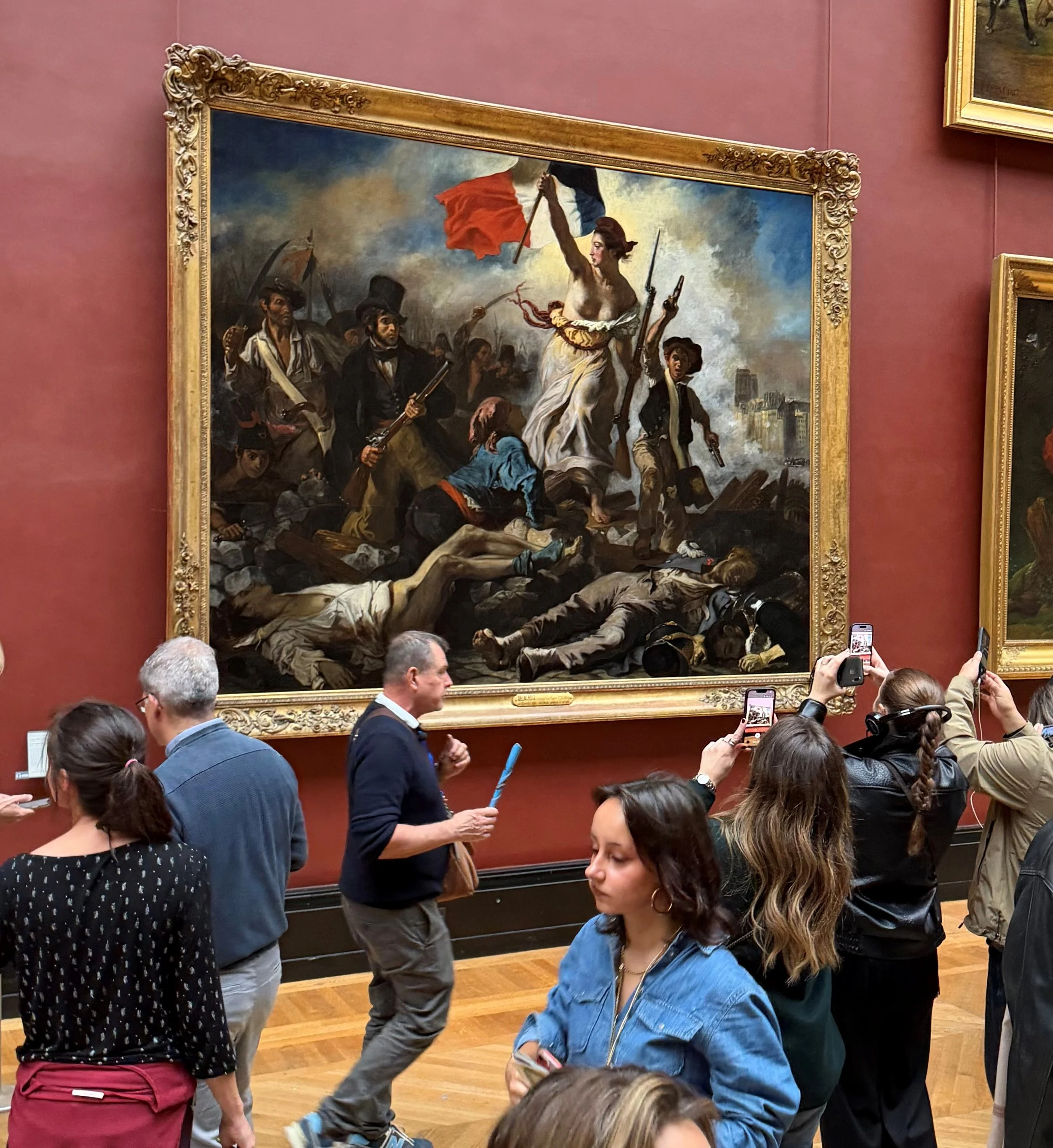
Eugène Delacroix, Liberty Leading the People (1830), Musée du Louvre, Paris. Photographed during my rescheduled visit last week. Nearly 200 years later, Liberty still draws a crowd. Getting through the museum doors, however, was another matter.
Paris during Art Basel was spectacular. It has become my favorite fair, and I have gone to many hundreds over many decades. I spotted Bernard Arnault at the avant-première and the Grand Palais was bursting with collectors. When I returned the following day, it was even more crowded. Museums were packed. Restaurants were fully booked. The appetite for art and culture seemed insatiable. Paris was having a very good week…until it wasn’t.
Monday of last week, my planned visit to the Louvre was canceled because students had blocked its entrances. I eventually managed to return, but not everyone was so lucky. Meanwhile, protests over education, wages and the cost of living had been accompanied by vandalism and looting.
By Friday, Art Basel had closed two days earlier amid fears of further unrest. Suddenly, a city celebrating art was making it extraordinarily difficult for people to experience it.
Liberty Has a Complicated History
One of my favorite paintings in art history is Eugène Delacroix’s Liberty Leading the People (1830). I’ve written extensively about his extraordinary abilities in my book and how relevant he remains today. Delacroix understood the power of political upheaval, and his painting remains one of the most stirring images of freedom ever created. I’m hardly going to argue that people should never protest.
But here’s a historical irony: the Louvre, once a royal palace, became a public museum during the French Revolution, opening in 1793. More than two centuries later, students protesting the state of public education prevented visitors from entering. Their grievances deserve to be heard.
Yet imagine someone traveling from Greece or Bulgaria, having saved for years to see the Mona Lisa, only to discover that the museum is closed on their one available day. I could reschedule. They might never get another chance.
The Little Guys Get the Bill
It’s tempting to imagine that vandalizing luxury stores sends a powerful message to the wealthy. But LVMH can absorb disruptions that might be devastating to a family-owned restaurant, a small shop or an independent gallery. Big companies have resources, insurance and financial cushions. Small businesses often have considerably less room for disaster. Some of the looted luxury goods reportedly turned up for sale online almost immediately. Apparently, capitalism is the enemy, until there's a handbag to flip.
A New York gallerist I know had rented a space in Le Marais for a month to stage her first international exhibition. She’s an independent entrepreneur, without a family fortune underwriting her business. Her opening reception was cut short by the riots, and her gallery was vandalized. Thankfully, the artworks were safe, and she cleaned up most of the damage herself. Imagine investing your money, energy and months of preparation into an exhibition abroad, only to spend your opening weekend dealing with vandalism.
There’s an uncomfortable question here: when destruction accompanies demands for a fairer society, why do some of its immediate costs fall on the very people with the least power to absorb them? Peaceful protesters and vandals aren’t necessarily the same people. But the consequences for those caught in the middle are painfully real.
VIP Access vs. Public Disappointment
Art Basel’s premature closure revealed another version of the same inequality. Major galleries often make substantial sales during the VIP previews, sometimes before the fair officially opens. They have international networks and direct access to collectors. Smaller galleries, however, depend much more heavily on every day of the fair to build relationships, introduce artists and recover the enormous expenses of participating.
And then there are the visitors. Saturday and Sunday are when families, students and art lovers who don’t have VIP invitations can finally wander through the Grand Palais. They may never buy a painting, but they can discover an artist, experience something extraordinary or simply enjoy being surrounded by art. Those two public days disappeared. A friend also told me about a woman who had saved to visit the Fondation Cartier, only to find it boarded up.
Art and politics have always been intertwined, and some of the greatest works in history emerged from moments of upheaval. But the consequences of our actions matter, especially when they fall on people who have little influence over the conflict itself.
Delacroix’s Liberty leads the people forward, French flag raised above the barricades. It’s an image of courage, conviction and the extraordinary power of collective action. But after a week in Paris, I kept thinking about the people left behind: the small gallerist, the shopkeeper, the family standing outside a closed museum. The wealthiest collectors had already had their moment inside. What a peculiar revolution, when those with the most lose the least, and those with the least are left sweeping up the glass.